Xi Jinping Reportedly Hugs Trump Ahead of Summit
Xi Jinping Reportedly Hugs Trump Ahead of a Possible Trump-Xi-Putin Summit
Multiple media reports say Chinese President Xi Jinping greeted Donald Trump with a hug after the US president arrived in China, ahead of anticipated discussions involving Russian President Vladimir Putin. The reported encounter drew attention because it showed the leaders of the United States and China in an unusually informal public moment before potentially significant three-way diplomacy.
The available reports describe the greeting as a hug, with one outlet calling it a surprise “bro-hug” during a tarmac welcome. Other coverage linked the encounter to a planned or anticipated trilateral summit involving Trump, Xi and Putin. However, the supplied reports do not independently confirm the summit’s precise location, schedule, agenda, participants beyond the three leaders or any resulting agreements.
The image may carry diplomatic significance, but the greeting alone does not establish a policy breakthrough. Its meaning will depend on official statements, the substance of the leaders’ discussions and any concrete follow-up measures.
What Happened During the Xi-Trump Greeting?
Reports describe a surprise hug
The central claim across the supplied coverage is that Xi greeted Trump warmly, with several reports describing the interaction as a hug. The Financial Times and Chosun Ilbo connected the greeting to a historic trilateral summit, while the New York Post emphasized the informal character of the encounter by describing it as a surprise “bro-hug” on a tarmac in China. Source 1
The reports do not provide reliable details about who initiated the embrace, how long it lasted, what the leaders said or whether the encounter involved substantive discussion. Those details should not be inferred from the gesture itself.
A warm greeting between senior leaders can attract intense coverage because public diplomatic rituals shape perceptions before negotiations begin. A handshake may communicate formality and protocol. An embrace appears more personal, although it can still be carefully managed and symbolic.
Trump reportedly arrived in China for high-level meetings
NPR’s supplied summary says Trump arrived in China for key meetings with Xi and Putin. The description places the greeting within a wider diplomatic visit rather than treating it as an isolated encounter. Source 3
The supplied material does not include a complete itinerary or official timetable. It therefore remains unclear whether Trump’s meetings with Xi and Putin were separate bilateral discussions, a formal three-leader summit or a combination of formats.
That distinction matters. A presidential arrival, a bilateral meeting and a trilateral summit are separate events. Reports about one should not automatically be treated as confirmation of the others.
Shenzhen is reported as a possible location
NewsCord reportedly said Xi personally greeted Trump in Shenzhen and compared coverage from 10 outlets. Source 5
That location should be treated as reported rather than independently confirmed. The available summary does not establish whether Shenzhen was the arrival point, the venue for formal talks or simply the setting described by one secondary report.
Readers should rely on official statements from the White House, China’s Ministry of Foreign Affairs and the Kremlin before treating the location and schedule as definitive.
Why the Hug Matters
Public gestures can shape diplomatic tone
Body language often becomes part of the diplomatic message. A cordial greeting can suggest that leaders want to reduce visible hostility, establish personal rapport or project confidence before difficult negotiations.
The embrace may be interpreted as:
- An attempt to lower tensions.
- A display of personal familiarity.
- A signal that communication remains open.
- A carefully staged image of stability.
- A way to create a positive atmosphere before talks.
None of these interpretations proves that the United States and China reached an agreement. Diplomatic warmth and strategic disagreement can exist at the same time.
A welcoming reception may coexist with disputes over trade, technology, security and regional influence. Public tone can improve without producing an immediate policy change.
The moment may reflect personal diplomacy
Trump has often emphasized relationships with foreign leaders in public statements. For that reason, a friendly interaction with Xi could receive particular attention. Supporters might view it as evidence that direct leader-to-leader contact can open channels that formal negotiations struggle to create.
Xi’s reported greeting may also have been intended to establish a controlled and respectful atmosphere. Host governments use arrivals, photographs and public welcomes to communicate hospitality and political confidence.
The available reports do not establish the private intentions of either leader. It is not possible to conclude that the hug reflected a concession, a change in negotiating strategy or a personal agreement.
Symbolism matters without proving a breakthrough
A summit produces more than formal documents. Images and gestures reach domestic audiences, foreign governments, investors and allied countries. The Xi-Trump embrace could therefore carry different meanings for different observers.
Some may see it as a sign that US-China tensions are easing. Others may view it as diplomatic theater before hard bargaining. Another interpretation is that the leaders were signaling pragmatism: cooperation may be limited, but communication remains necessary.
The most reliable test will be what happens after the photo opportunity. Policy announcements, official readouts and follow-up negotiations matter more than the greeting alone.
The Reported Trilateral Summit
Three major powers, different interests
A meeting involving the United States, China and Russia would carry substantial geopolitical weight. The three governments have different national interests, security concerns and economic priorities. They may share opposition to some aspects of the existing international order, but that does not mean they have identical objectives.
A trilateral format would also be more complex than a bilateral Xi-Trump meeting. Each leader would need to address two relationships at once while using the presence of the third leader to communicate broader strategic positions.
The supplied reports describe the summit as anticipated or historic, but they do not provide a verified agenda or outcome. Discussion of possible subjects should therefore remain conditional.
Possible topics
A Trump-Xi meeting could potentially address trade, tariffs, technology restrictions, semiconductor supply chains, economic competition, military communication and regional security. These are longstanding areas of US-China tension, not confirmed agenda items in the supplied reports.
A Trump-Putin discussion could potentially include European security, sanctions, arms control, strategic weapons, diplomatic communication and conflict-related negotiations.
Xi and Putin could also discuss energy trade, economic cooperation, strategic coordination, regional security, trade routes and investment. China and Russia cooperate in some areas, but their interests are not identical.
Why a three-way meeting would be unusual
US-China and US-Russia relations are usually managed through separate diplomatic channels. Bringing all three leaders together could serve several purposes:
- Demonstrating the host country’s diplomatic influence.
- Exchanging broad strategic messages.
- Exploring limited areas of cooperation.
- Creating channels for future negotiations.
- Showing that major powers can communicate despite serious disputes.
A trilateral meeting would not automatically create a formal alliance. Cooperation, coordination and alliance are different concepts. A single summit could produce dialogue without creating permanent commitments.
What Trump’s Arrival in China Signals
Trump’s reported arrival placed US-China relations at the center of international attention. A presidential visit to China would carry significance regardless of the greeting because it would provide an opportunity to manage confrontation directly.
Possible objectives could include testing personal rapport, pursuing economic interests, addressing security concerns and demonstrating negotiating leverage. The visit could also allow both governments to shape the public narrative around a relationship often defined by competition.
However, a warm welcome does not eliminate disputes over:
- Trade policy.
- Tariffs.
- Technology exports.
- Supply-chain security.
- Military activity.
- Regional influence.
- Human rights.
- Economic competition.
Readers should distinguish among the tone of the meeting, the substance of negotiations and the final policy outcome. A cordial welcome describes tone. It does not reveal the content of negotiations or prove that either government changed policy.
How Media Framed the Moment
The supplied Financial Times and Chosun Ilbo summaries emphasize Xi’s reported hug and its connection to a trilateral summit. Source 1 Source 9
NPR’s supplied summary focuses on Trump’s arrival in China and meetings involving Xi and Putin. Source 3
The New York Post centers its account on the unexpected “bro-hug” during a tarmac greeting. Source 7
NewsCord reportedly compared coverage from 10 outlets and identified Shenzhen as the setting of Xi’s welcome. Because the supplied material describes this as a comparison report rather than an official statement, the location and other details require confirmation. Source 5
What the Hug Does Not Prove
It does not confirm a diplomatic agreement
No supplied source summary identifies a signed agreement, negotiated settlement or formal policy change resulting from the greeting.
It does not establish a strategic alliance
A public embrace cannot prove that Washington, Beijing and Moscow formed an alliance. It may signal openness, courtesy or image management without creating lasting obligations.
It does not reveal the private conversation
The available summaries do not disclose what Xi and Trump discussed. Motives, promises and emotional reactions should not be invented.
It does not confirm the summit’s outcome
The reported greeting, Trump’s arrival, the anticipated summit and any eventual agreement are separate facts. Official readouts are required to establish whether the meeting occurred and what it produced.
Possible Implications for Global Politics
A cordial meeting could create room for additional US-China negotiations, but sustained improvement would require concrete follow-up, such as working groups, new leader-level meetings, changes in trade policy or stronger military communication.
Putin’s reported participation would place Russia at the center of a major diplomatic event. Moscow could use the setting to communicate directly with Washington and Beijing, but that would not mean the three governments reached a common position.
US allies and other strategic partners would monitor the tone between Washington and Beijing, Russia’s role and any references to regional security. Some governments might welcome reduced tensions while remaining concerned about decisions reached without their participation.
Financial markets may respond to statements about tariffs, sanctions, energy policy and technology restrictions. Symbolic warmth alone does not guarantee economic de-escalation.
What to Watch After the Summit
Readers should examine official statements from:
- The White House.
- China’s Ministry of Foreign Affairs.
- The Kremlin.
The most important evidence will be concrete follow-up, including:
- New negotiations.
- Trade commitments.
- Diplomatic working groups.
- Military hotlines.
- Joint declarations.
- Changes to tariffs or export controls.
- Changes to sanctions or military policy.
- Announced future meetings.
Policy changes provide stronger evidence than a cordial greeting. If the embrace leads to sustained talks and measurable commitments, its diplomatic significance will increase. If no follow-up occurs, it may remain primarily a striking ceremonial image.
Conclusion
The supplied reports say Xi Jinping greeted Donald Trump with a hug after Trump arrived in China, ahead of discussions involving Vladimir Putin. The encounter created an unusual image of personal warmth among leaders associated with major geopolitical tensions. Source 1
The hug may signal a desire for a positive diplomatic atmosphere, but it does not prove that the United States and China resolved their disputes, that a formal trilateral summit occurred or that the three countries reached an agreement.
The significance of the moment will depend on what follows: official agendas, summit statements, policy decisions and sustained negotiations. The greeting establishes a tone. Concrete action will determine the outcome.
Frequently Asked Questions
Did Xi Jinping really hug Donald Trump?
Several supplied reports, including coverage attributed to the Financial Times, Chosun Ilbo and the New York Post, describe Xi greeting Trump with a hug. The available summaries do not explain who initiated the gesture, how long it lasted or what the leaders said. Source 7
Where did Xi greet Trump?
NewsCord reported that Xi personally greeted Trump in Shenzhen. The other supplied summaries do not independently confirm the location. Shenzhen should therefore be treated as a reported detail until official sources verify it. Source 5
Why were Trump, Xi and Putin reportedly meeting?
NPR’s supplied summary says Trump arrived in China for key meetings with Xi and Putin, but it does not provide a confirmed agenda. Possible subjects include trade, security, sanctions and strategic relations. Source 3
Was the hug a sign that US-China tensions ended?
No. A warm public greeting can improve the diplomatic atmosphere, but it does not prove that disputes over trade, technology, security, human rights or regional influence ended.
Did the trilateral summit produce an agreement?
The supplied summaries do not identify a confirmed agreement or outcome. Official statements from the United States, China and Russia would be needed to establish whether the meeting produced concrete commitments.
What should readers watch next?
Readers should monitor official readouts, policy announcements and follow-up negotiations. Changes in tariffs, sanctions, export controls, military communication or diplomatic scheduling will provide more evidence than the hug alone.
Related Articles
-
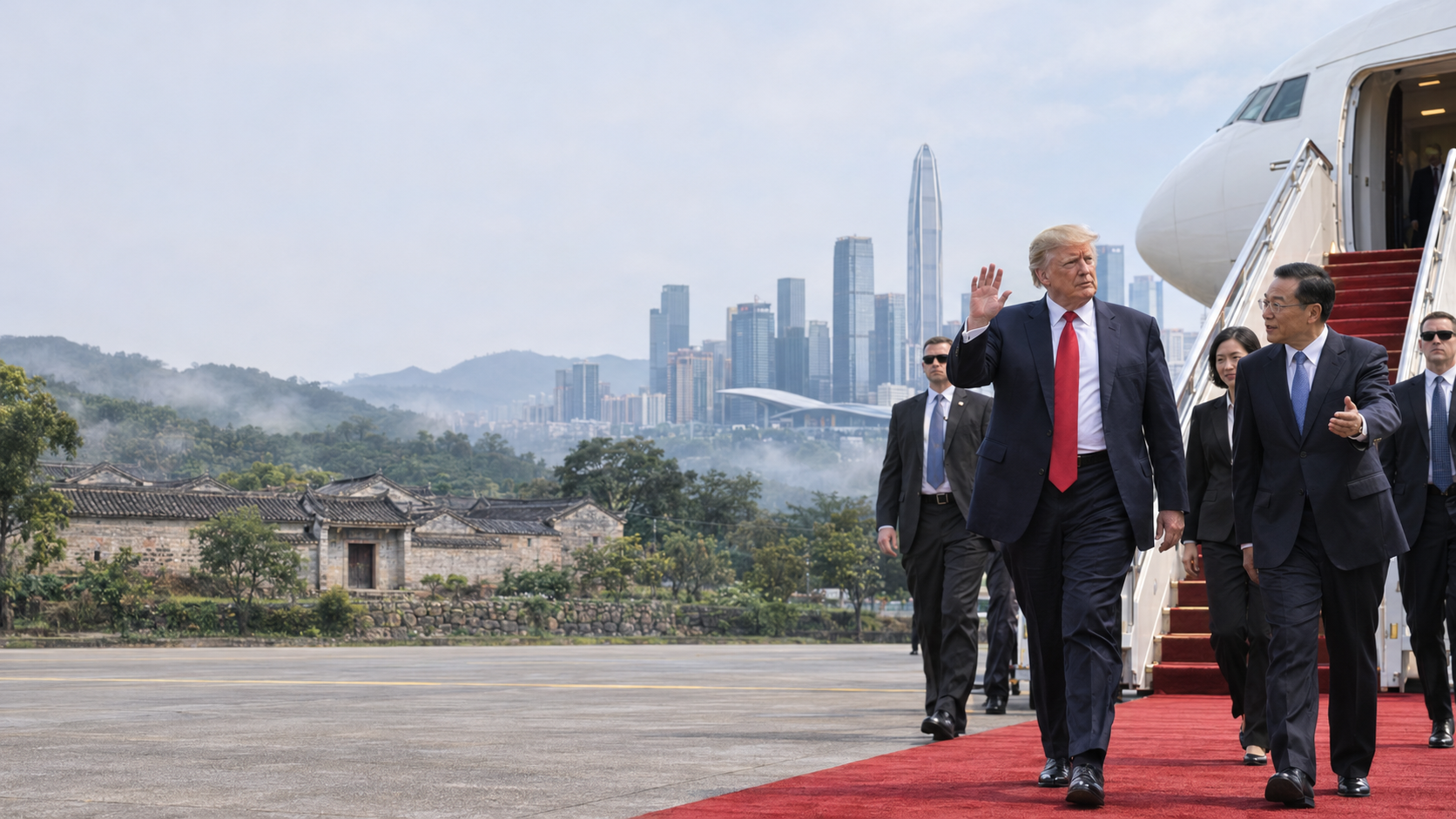 Trump’s Shenzhen Arrival and Xi’s Family History
-
 Ukraine Reportedly Struck Crimean Bridge Without Starlink
-
 Iran-Kuwait Air Base Attack: What We Know
-
 Putin’s Asia Visit Highlighted by Russian Tu-95 Bombers
-
 Democrats Nominate Hakeem Jeffries for House Speaker
-
 Markwayne Mullin Faces Scrutiny Over Football Trip
-
 Letters to 12 Trump Associates Remain Unverified
-
 Los Angeles County Issues Health Order Over Landfill Gas Plume
-
 Trump Projects Strength on China as Tech Failures Raise Concerns
-
 Modi, Trump Awkward Quad Photo-Op: What Footage Shows
-
 Ukraine Seeks Air Defense as Peace Talks Narrow
-
 Oversight Democrats Signal Scrutiny of Trump Allies
-
 Chiquita Canyon Landfill Trash Geyser Raises Health Concerns
-
 Mary Peltola and Alaska's Senate Balance: Fact-Check
-
 Rubio Says No Evidence Links Recent Tech Outages
-
 Reported Iran Attacks on Kuwait and Bahrain Escalate Gulf Crisis