Los Angeles County Issues Health Order Over Landfill Gas Plume
Los Angeles County Issues Health Order Over Landfill Gas Plume
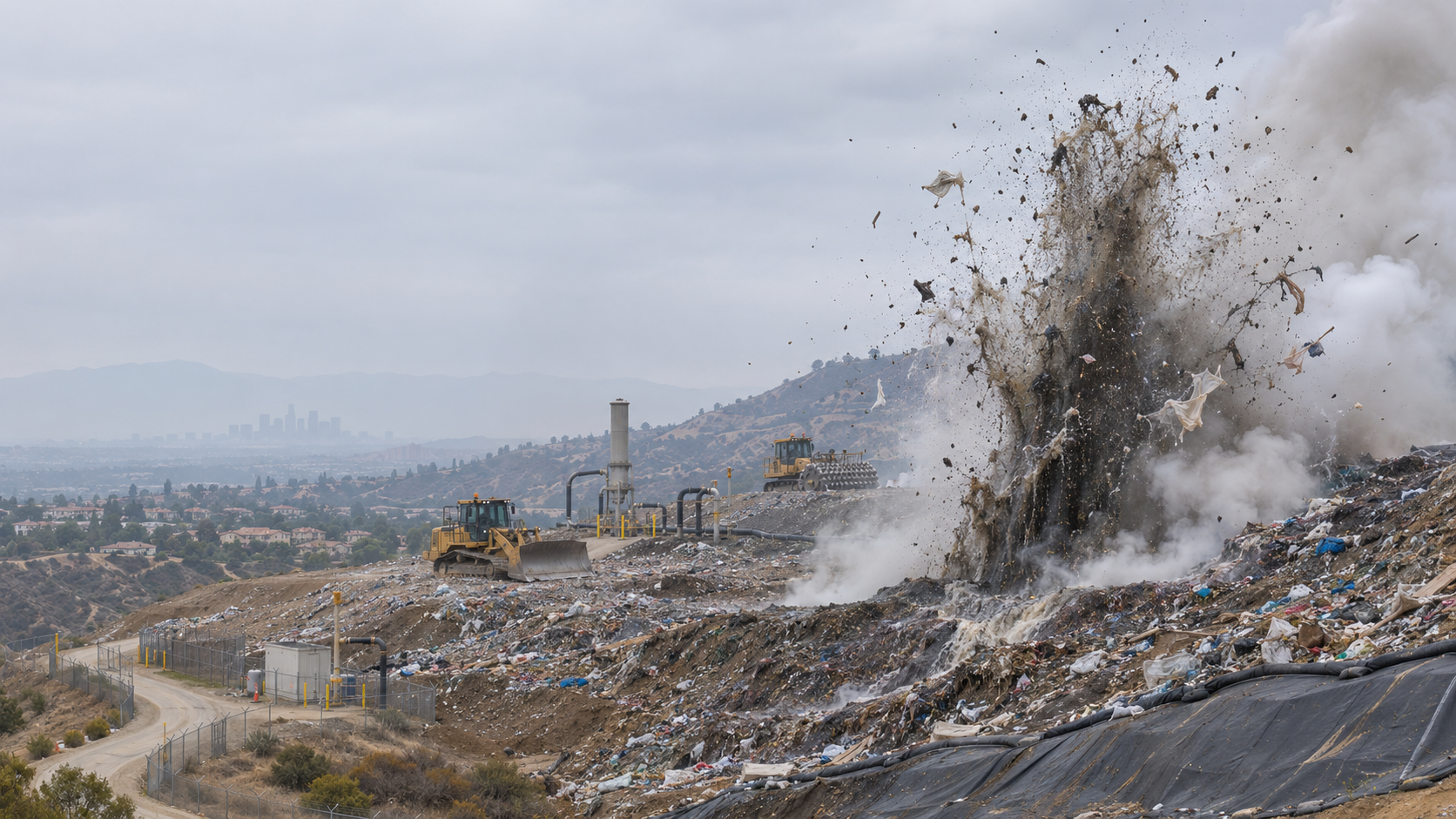
A plume associated with decomposing garbage and landfill gas prompted Los Angeles County officials to issue an emergency health order advising residents to take precautions. Reports described foul odors and what KTLA characterized as a large “geyser” of rotting trash, while other coverage referred to a gas plume linked to decomposing waste. Source 1
The order is a precautionary public-health response to possible airborne pollution. It does not establish that every resident was exposed, that a particular contaminant caused illness, or that long-term health effects have been confirmed.
Available reports connect decomposing garbage, landfill gas, foul odors, and the emergency order. They do not yet establish the facility’s precise location, the plume’s size or duration, detected chemicals, measured air-quality levels, confirmed illnesses, or the order’s expiration date. Those details require confirmation from Los Angeles County and relevant environmental and public-health agencies.
What Happened?
News reports described an unusual release involving decomposing garbage and landfill gas. KTLA called the event a massive geyser of rotting trash, while other coverage emphasized foul-smelling gas and airborne pollution. Source 3
The available summaries do not identify the mechanical or environmental cause. Possible explanations include waste movement, a pressure release, a gas-collection-system problem, a landfill-slope issue, or another site-specific event. None should be treated as confirmed without an official investigation.
The reports also do not identify the landfill, affected neighborhoods, incident date, plume boundaries, or weather conditions. Those facts should be added only after verification through official county announcements or original reporting.
Why Officials Issued the Health Order
Officials issued the emergency order because the release could expose nearby residents to airborne pollutants or irritating odors. Source 1
An emergency order allows public-health officials to issue protective instructions while agencies investigate the release and monitor air conditions. It signals concern about potential exposure, but it does not mean that all county residents face the same risk or that confirmed injuries have occurred.
Residents should verify:
- Which agency issued the order.
- Whether it applies countywide or to a defined area.
- Whether officials require sheltering indoors or evacuation.
- Whether windows and doors should remain closed.
- Whether outdoor work, exercise, school activities, or business operations are affected.
- How to report symptoms or obtain updates.
- When the order will be reviewed or lifted.
Follow the official order rather than headlines, neighborhood posts, or assumptions about the affected area. Source 5
How Landfill Gas Forms
Landfill gas forms when organic materials such as food scraps, yard waste, paper, and wood decompose in oxygen-limited conditions. After available oxygen is consumed, anaerobic microorganisms produce gases that can collect within waste layers or travel through soil, cracks, drainage paths, and landfill infrastructure.
Moisture, temperature, waste composition, compaction, site design, and gas-collection systems affect how much gas forms and where it moves. Landfill operators generally use collection, control, monitoring, or treatment systems to manage it.
Methane and carbon dioxide are the principal components commonly associated with landfill gas. Methane is flammable under suitable conditions. Carbon dioxide is generally odorless and can displace oxygen in confined spaces at high concentrations. Other compounds may cause strong odors or irritate the eyes and respiratory system, but their presence in this incident requires confirmation through testing or official statements.
Odor intensity cannot determine whether air contains a dangerous pollutant concentration. Conversely, the absence of an odor does not prove that air is safe because some gases are odorless and odor fatigue can reduce detection. Residents should rely on official monitoring and instructions rather than smell alone.
Do not approach the landfill, enter restricted areas, investigate visible emissions, or use flames and ignition-producing equipment near a suspected release.
Potential Health Risks
Airborne pollutants, gases, particles, and strong odors can irritate the eyes, nose, throat, and airways. Possible symptoms include:
- Burning or watery eyes.
- Nose or throat irritation.
- Coughing.
- Headache.
- Nausea.
- Dizziness.
- Wheezing.
- Shortness of breath.
These symptoms do not prove that a specific landfill contaminant caused them. They can also result from anxiety, heat, unrelated illness, existing respiratory disease, or other environmental exposures.
Children, older adults, pregnant people, individuals with asthma or chronic obstructive pulmonary disease, people with heart or lung disease, outdoor workers, first responders, and cleanup personnel may face greater sensitivity. Risk depends on concentration, exposure duration, wind direction, distance, ventilation, protective equipment, and individual health.
People with respiratory conditions should keep prescribed medication available and follow their healthcare professional’s action plan. They should not change medication doses without medical advice.
When to Seek Medical Help
Call emergency services for severe difficulty breathing, chest pain, fainting, confusion, blue or gray lips, severe weakness, or rapidly worsening symptoms. Contact a healthcare professional for concerning but non-life-threatening symptoms. Do not delay emergency treatment while trying to identify the specific gas.
When seeking care, describe the approximate location, time, duration, symptoms, and county warnings in effect.
An emergency order does not establish long-term health effects. Reliable risk assessment requires air-monitoring data, laboratory analysis, exposure estimates, medical information, weather conditions, and evidence about the release’s duration.
What Residents Should Do
Follow Official Instructions
Obtain the full order from Los Angeles County or the responsible public-health agency. Check the official map, neighborhood list, evacuation zone, or shelter-in-place boundary. Recommendations may change as monitoring and containment work continue.
Reduce Outdoor Exposure
Until officials provide updated guidance:
- Limit outdoor time near the reported plume.
- Postpone strenuous outdoor exercise in affected areas.
- Move children’s activities indoors when advised.
- Keep children and pets away from emissions, waste, runoff, and restricted zones.
- Avoid walking or driving through smoke, gas, liquid waste, or visibly contaminated material.
- Do not enter landfill property to inspect or photograph the release.
Outdoor workers should follow employer and agency safety instructions. Ordinary masks may not protect against gases.
Improve Indoor Air Conditions
If officials advise sheltering indoors:
- Close windows and exterior doors.
- Turn off systems that intentionally bring outdoor air inside, when appropriate.
- Use air conditioning or filtration according to manufacturer instructions.
- Avoid smoking, burning candles, or using fuel-burning equipment indoors.
- Never use generators, grills, or fuel-burning devices inside homes, garages, or enclosed areas.
Portable air cleaners may reduce some particles but may not remove every gas. They are not substitutes for evacuation or other official instructions.
Evacuate When Ordered
If authorities issue an evacuation order, leave promptly using designated routes. Take essential medications, identification, documents, phone chargers, and supplies for children, older adults, and pets. Do not return until officials confirm that reentry is safe.
Report Symptoms and Environmental Concerns
Use official channels to report strong or unusual odors, visible emissions, suspected releases, symptoms affecting multiple household members, or health concerns after leaving the area. Record the approximate time, location, weather, odor duration, visible conditions, and symptoms. Do not approach the source to gather information.
What Authorities May Do
Agencies may monitor methane, carbon dioxide, hydrogen sulfide, volatile organic compounds, particulate matter, and oxygen levels in affected or confined areas. Results should identify the pollutant, concentration, sampling location and time, weather conditions, health benchmark, and any action triggered by the result.
A single reading may not represent an entire neighborhood. Concentrations can change with wind, temperature, atmospheric mixing, and waste or gas movement.
Possible response measures include covering exposed waste, controlling leaks, managing landfill pressure, repairing or adjusting gas-collection systems, stabilizing affected material, and improving containment. These are general options, not confirmed actions in this incident.
Residents should monitor Los Angeles County public-health announcements, emergency-management alerts, air-quality agency updates, municipal notices, and official facility communications. Public notices should include publication and update times so residents can distinguish current instructions from outdated reports.
What Remains Unknown
Important unanswered questions include:
- Which facility released the plume?
- Which communities and roads fall within the exposure area?
- What chemicals were detected, and at what concentrations?
- How long did the release continue?
- What caused the event?
- How long will the health order remain in effect?
- Have any illnesses, hospitalizations, or confirmed exposures occurred?
- Which agencies oversee monitoring, enforcement, cleanup, and investigation?
Technical results should be published with plain-language explanations of what each measurement means and what protective action follows.
Conclusion
A plume associated with decomposing garbage and landfill gas was reported in Los Angeles County, prompting an emergency health order because of potential airborne risks. Source 5
The precise contaminants, exposure boundaries, cause, duration, and health effects require confirmation through official monitoring and investigation. Residents should limit exposure, avoid restricted areas, follow shelter or evacuation instructions, and seek medical help for severe or worsening symptoms. Use Los Angeles County alerts and public-health updates for current guidance.
Frequently Asked Questions
What caused the Los Angeles County garbage plume?
Reports attributed it to decomposing garbage and landfill gas. Available summaries do not establish whether the specific cause was a gas-system failure, waste movement, pressure release, or another event.
Is landfill gas dangerous to breathe?
Landfill gas commonly contains methane and carbon dioxide, along with smaller amounts of other compounds. Risk depends on composition, concentration, exposure duration, ventilation, and distance from the source. Follow the health order and avoid affected areas.
What should residents do if they smell rotting garbage or gas?
Move away from the odor or visible plume, avoid restricted areas, and follow county instructions. If officials advise sheltering indoors, close windows and doors and reduce outdoor-air entry as directed. Report symptoms through official channels.
What symptoms can exposure cause?
Possible symptoms include eye, nose, or throat irritation, coughing, headache, nausea, dizziness, and breathing difficulty. Seek urgent care for severe breathing problems, chest pain, confusion, fainting, blue or gray lips, or rapidly worsening symptoms.
Does the order apply to every Los Angeles County resident?
Available reports do not specify the geographic boundaries. Check the official order for affected neighborhoods, facilities, evacuation zones, or shelter-in-place areas.
How long will the health order remain in effect?
The duration depends on monitoring results, containment efforts, and the county’s assessment of ongoing risk. Check official Los Angeles County updates for the order’s status and review date.
Related Articles
-
 Trump’s Shenzhen Arrival and Xi’s Family History
-
 Ukraine Reportedly Struck Crimean Bridge Without Starlink
-
 Iran-Kuwait Air Base Attack: What We Know
-
 Putin’s Asia Visit Highlighted by Russian Tu-95 Bombers
-
 Democrats Nominate Hakeem Jeffries for House Speaker
-
 Markwayne Mullin Faces Scrutiny Over Football Trip
-
 Letters to 12 Trump Associates Remain Unverified
-
 Xi Jinping Reportedly Hugs Trump Ahead of Summit
-
 Trump Projects Strength on China as Tech Failures Raise Concerns
-
 Modi, Trump Awkward Quad Photo-Op: What Footage Shows
-
 Ukraine Seeks Air Defense as Peace Talks Narrow
-
 Oversight Democrats Signal Scrutiny of Trump Allies
-
 Chiquita Canyon Landfill Trash Geyser Raises Health Concerns
-
 Mary Peltola and Alaska's Senate Balance: Fact-Check
-
 Rubio Says No Evidence Links Recent Tech Outages
-
 Reported Iran Attacks on Kuwait and Bahrain Escalate Gulf Crisis