Voyager 1 Reaches One-Light-Day Milestone
Voyager 1 Reaches the One-Light-Day Milestone Despite a Communications Glitch
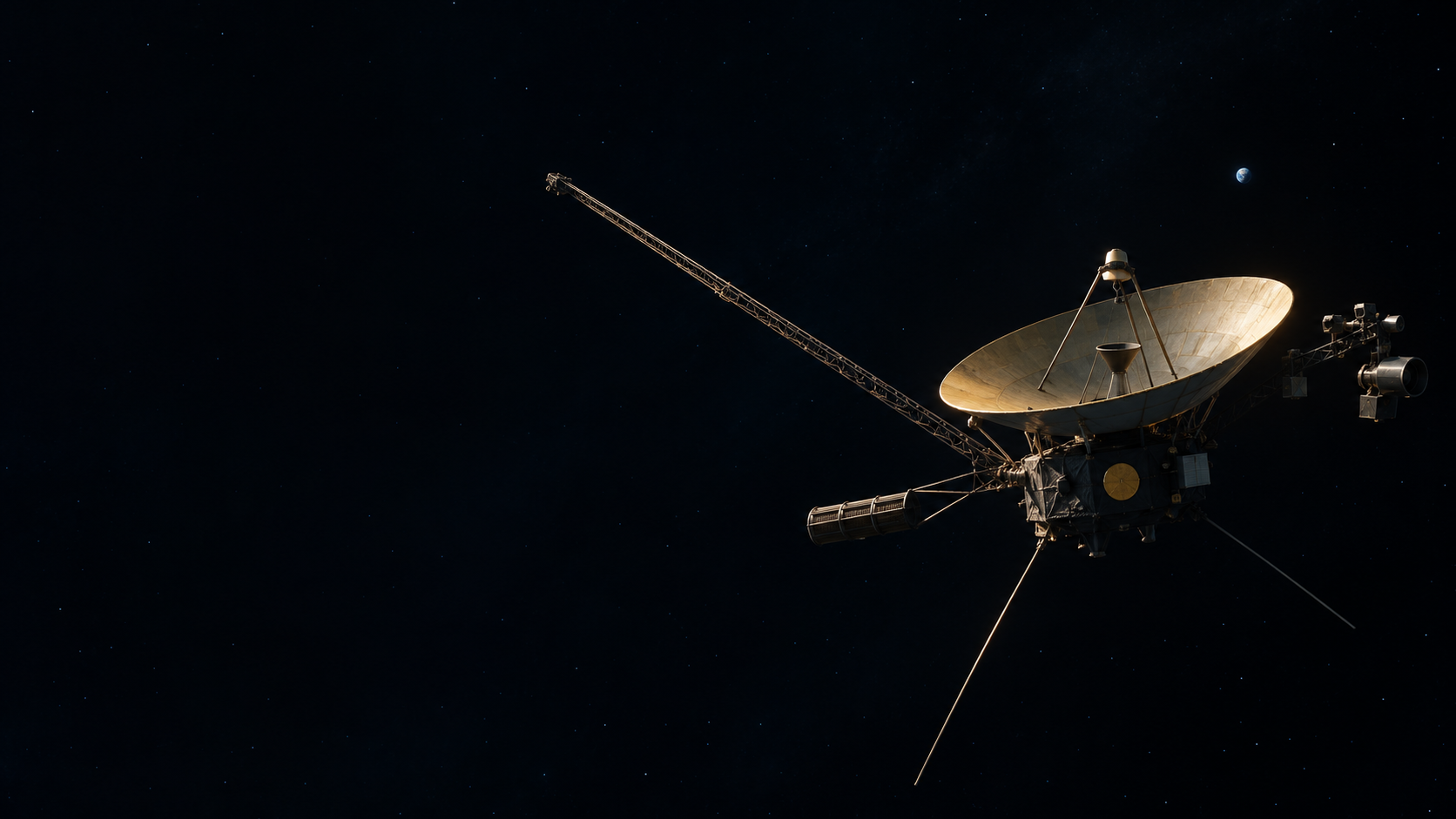
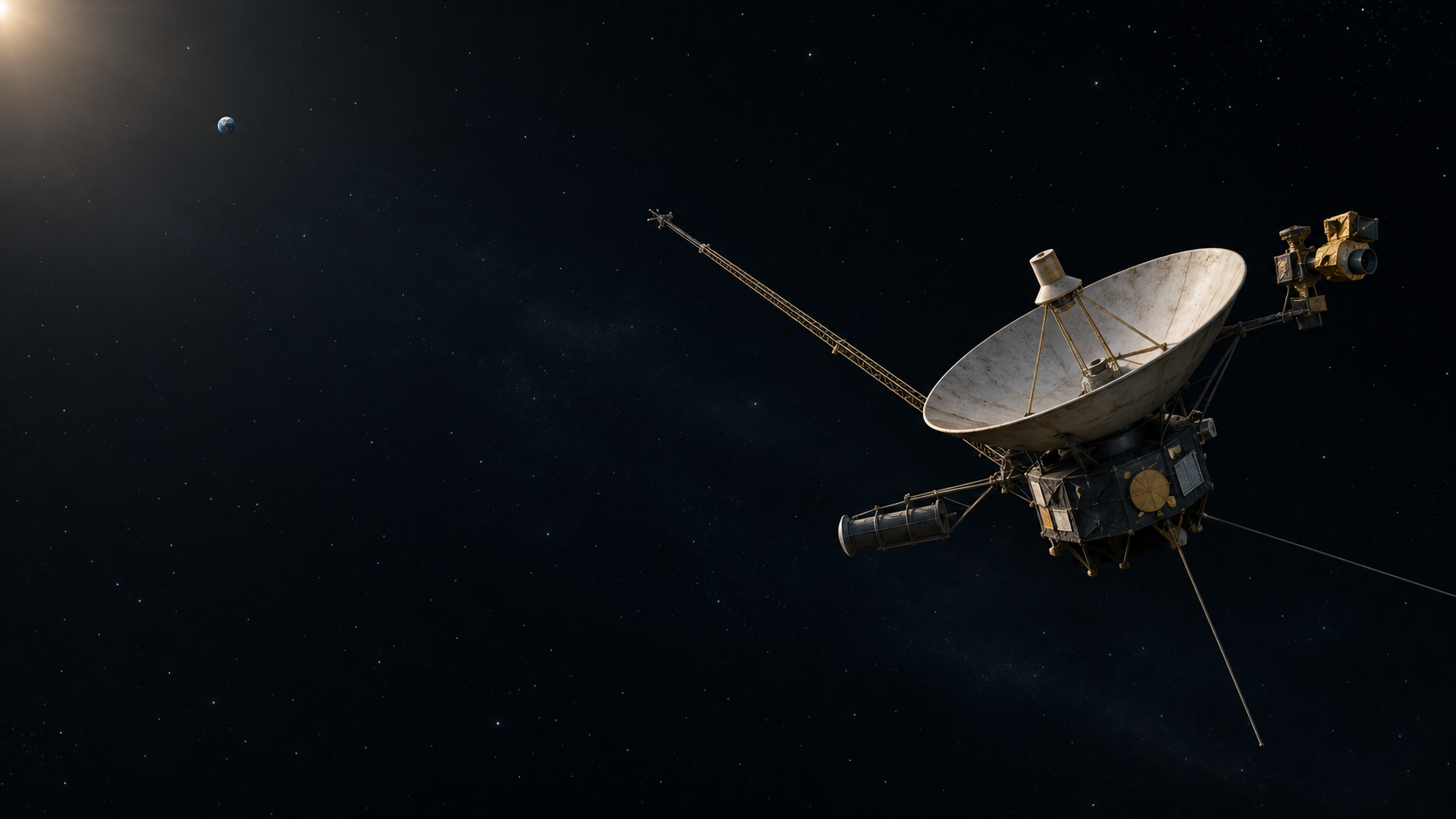
Voyager 1 has reached an approximate distance of one light-day from Earth while engineers work to diagnose another communications problem affecting the historic spacecraft.
Launched by NASA on September 5, 1977, Voyager 1 continues to travel outward through interstellar space. At its current distance, a radio signal traveling at the speed of light needs roughly 24 hours to cover the one-way journey between Earth and the spacecraft. A command-and-response cycle can therefore take about two days before engineers know how Voyager 1 reacted.
The milestone describes distance, not travel time. Voyager 1 did not take one day to reach its current location; it has been moving away from Earth for nearly five decades.
What One Light-Day Means
A light-day is the distance light travels in 24 hours. Because light travels at approximately 299,792 kilometers per second, one light-day equals about 15.5 billion miles, or 25 billion kilometers.
Three measurements should remain distinct:
- Spacecraft distance: the distance between Earth and Voyager 1.
- Signal delay: the time required for a radio transmission to travel between Earth and the spacecraft.
- Mission duration: the time since Voyager 1 launched in 1977.
One light-day is more than 25,000 times the average Earth–Moon distance and more than 160 times the average Earth–Sun distance. Voyager 1’s distance from Earth should not be confused with its position relative to the Sun or with the boundary of the solar system.
Voyager 1 crossed the heliopause years before reaching this Earth-distance milestone. The heliopause marks the region where the solar wind gives way to the interstellar medium.
Voyager 1’s Journey to Interstellar Space
Voyager 1 launched after Voyager 2 but followed a faster outward trajectory. Its original mission focused on Jupiter and Saturn, where it studied planetary atmospheres, magnetic fields, rings, and moons.
The spacecraft benefited from gravity assists. During such an encounter, a spacecraft uses a planet’s motion and gravitational field to change its speed and direction. Voyager 1’s encounters with Jupiter and Saturn placed it on a trajectory that carried it rapidly away from the planetary region.
NASA determined that Voyager 1 entered interstellar space after crossing the heliopause. This does not mean that it has reached another star. The spacecraft remains on an outward trajectory and will take tens of thousands of years to pass relatively close to another star.
Beyond the heliopause, Voyager 1 has measured plasma, magnetic fields, energetic particles, and interactions between the Sun’s extended environment and interstellar space. These observations offer data from a region that no Earth-based observatory can directly sample.
The Communications Glitch
Reports describe another technical communications glitch affecting Voyager 1. Available summaries do not identify a verified failed component. The problem could involve corrupted data, the loss of a communication pathway, unusable telemetry, or a temporary interruption during troubleshooting.
It should not automatically be described as permanent silence. Engineers are reviewing the spacecraft’s status and working to restore reliable communications. That status may change as new commands are sent and additional telemetry reaches Earth.
Troubleshooting is difficult because Voyager 1 was designed in the 1970s and has operated for nearly five decades. Its electronics are aging, its power supply is declining, and many systems have been switched off or reconfigured to preserve essential functions.
The main challenges include:
- A signal delay of roughly one day in each direction.
- Extremely weak transmissions by the time they reach Earth.
- Declining power from the spacecraft’s radioisotope thermoelectric generator.
- Aging computer and communications hardware.
- Limited memory and processing capacity.
- Reduced availability of heaters and scientific instruments.
- The inability to inspect or repair the spacecraft physically.
Engineers must prepare commands conservatively. Each attempted fix can require multiple communication cycles before the team can evaluate its result. Archived documentation, legacy software knowledge, and the experience of engineers familiar with Voyager’s architecture remain essential.
Why Voyager 1 Reached One Light-Day First
Voyager 2 launched before Voyager 1, but the two spacecraft followed different trajectories. Voyager 1’s gravity-assisted encounters with Jupiter and Saturn placed it on a faster path away from the Sun.
Voyager 2 took a longer route that enabled a rare tour of Jupiter, Saturn, Uranus, and Neptune. It remains the only spacecraft to have conducted close flybys of Uranus and Neptune.
Voyager 1 reached the one-light-day milestone first because of its trajectory, not its launch order. The two spacecraft were optimized for different scientific and navigation goals.
Why Voyager 1 Still Matters
Voyager 1 is both a scientific observatory and an engineering achievement. Its instruments continue to provide measurements from beyond the heliopause, helping scientists study:
- The structure of the outer heliosphere.
- Interstellar plasma.
- Magnetic-field boundaries.
- Energetic particles.
- The Sun’s influence on its galactic surroundings.
The spacecraft also carries the Voyager Golden Record, which contains sounds, music, images, and greetings intended to represent Earth and human civilization. The record does not guarantee discovery by another civilization, but it gives the mission lasting cultural significance.
Voyager 1’s longevity depends on careful power management, redundant systems, conservative commands, archived technical records, and continuous prioritization of mission objectives. The spacecraft was not designed to operate indefinitely, yet it has survived far beyond its original planetary mission.
What Happens Next?
Engineers will continue reviewing telemetry, testing communication pathways, sending carefully prepared commands, and analyzing results after the long signal delay. Possible recovery work could include adjusting data-transmission methods, checking alternate pathways, and reconstructing the events that preceded the glitch.
No specific recovery date should be assumed unless NASA provides one. Recovery is not guaranteed, but even limited or intermittent operations could remain scientifically valuable.
Voyager 1’s one-light-day milestone is not the end of its journey. The spacecraft continues moving outward as the communication gap between Earth and the probe grows.
Conclusion
Voyager 1 is approximately one light-day from Earth, about 25 billion kilometers away, with a one-way signal delay of roughly 24 hours. Its journey began with a 1977 launch, continued through gravity-assisted encounters with Jupiter and Saturn, and carried it beyond the heliopause into interstellar space.
The current communications glitch presents a serious technical challenge, but it does not diminish Voyager 1’s record. The spacecraft remains the farthest human-made object and one of the longest-running scientific missions ever conducted.
NASA engineers continue working to preserve contact and extract more knowledge from the distant probe. Voyager 1’s journey combines scientific discovery, cultural meaning, and sustained human ingenuity—and it is still continuing.
Frequently Asked Questions
How far away is Voyager 1?
Voyager 1 is approximately one light-day from Earth. Light, including a radio signal, takes about 24 hours to travel between Earth and the spacecraft. The exact distance changes continuously.
What is a light-day?
A light-day is the distance light travels in one day. It equals approximately 15.5 billion miles, or 25 billion kilometers.
Why is communication with Voyager 1 so difficult?
Signals need roughly one day to travel in either direction. Voyager 1 also has aging electronics, declining power, limited computing resources, and an extremely weak transmission by the time its signal reaches Earth.
What caused the communications glitch?
Available reports describe a technical communications glitch but do not provide enough verified information to identify a failed component. Engineers are working to diagnose the problem and restore reliable communication.
Did Voyager 1 launch before Voyager 2?
No. Voyager 1 launched on September 5, 1977, after Voyager 2. It reached the one-light-day milestone first because it followed a faster outward trajectory.
Is Voyager 1 still in the solar system?
Voyager 1 is operating in interstellar space after crossing the heliopause. It remains on an outward journey and has not reached another star.
Related Articles
-
 BepiColombo’s Eight-Year Journey to Mercury
-
 Could Known Particle Physics Explain Dark Energy?
-
 Nearby Triple-Star System That “Shouldn’t Exist” Explained
-
 How Science Can Prevent a Biological Apocalypse
-
 Welopōʻai: A Triple-Star System 28 Light-Years Away
-
 Star Eating Its Companion: What the Images Reveal
-
 Potatoes Grown in Simulated Moon Soil: Why It Matters
-
 BepiColombo’s Mercury Orbit Insertion Explained
-
 Leonid Meteor Shower 2026: How to Watch the Peak
-
 How Failed Supernovae May Create Black Holes
-
 Gravity Messaging: What the Elevator Experiment Shows
-
 Voyager 1 Sends a Signal From One Light-Day Away
-
 What If Space and Time Are Not Fundamental?
-
 Why Potatoes Could Feed Future Moon Bases
-
 Hera’s First Close-Up Reveals a Strange Asteroid
-
 What’s Next for NASA’s Voyager 1 Probe?