Spacecraft Reaches Mercury After Eight-Year Journey
Spacecraft Reaches Mercury’s Orbit After Eight-Year Journey
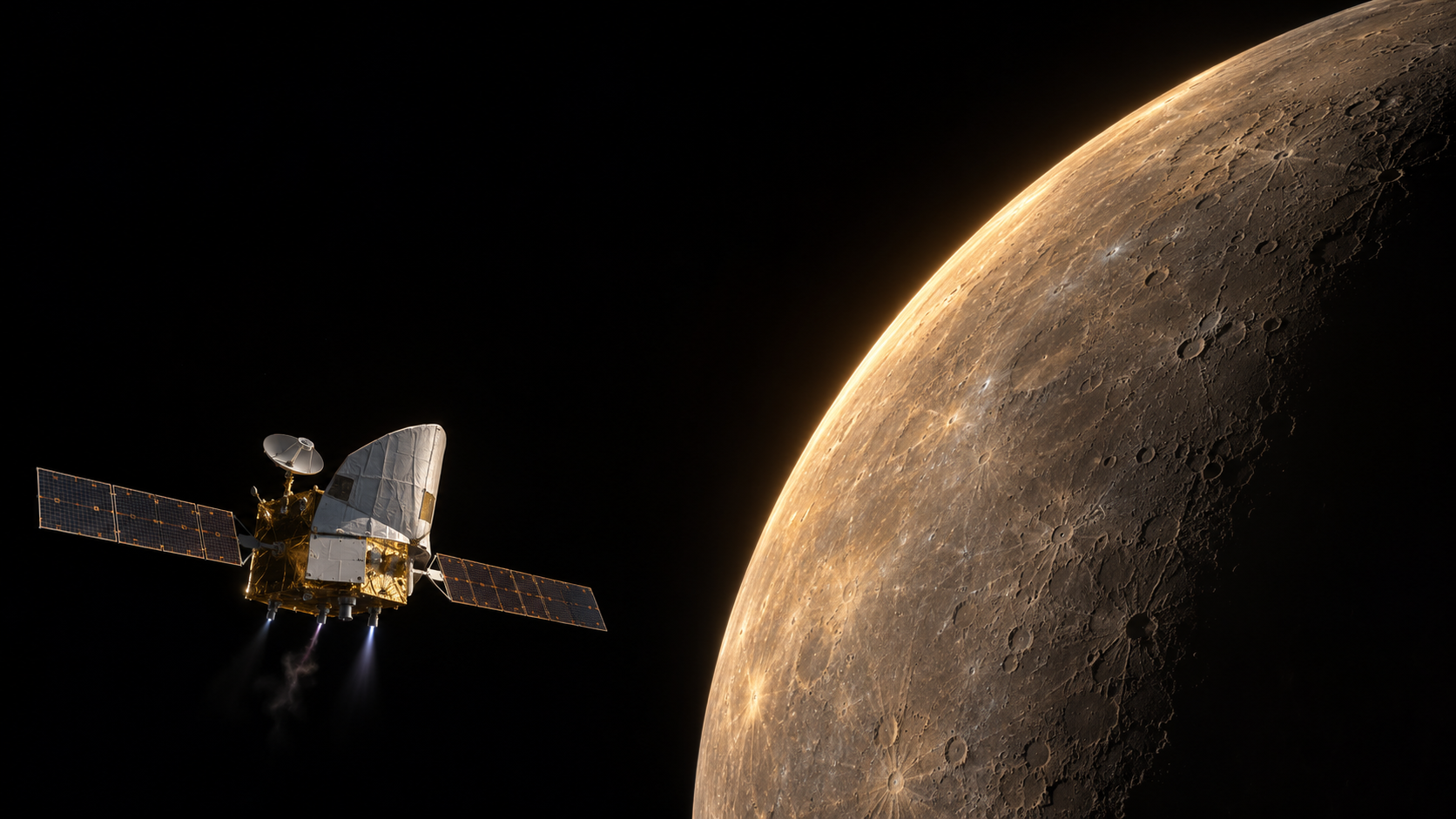
A spacecraft has reached Mercury’s orbit after an eight-year journey, overcoming a technical glitch that threatened to complicate one of the mission’s most demanding phases. The achievement marks a major milestone in planetary exploration because Mercury is difficult to reach, difficult to orbit, and difficult to study.
CBS News reported that the spacecraft overcame the problem before successfully entering orbit around the innermost planet in the Solar System. The available report summary does not identify the spacecraft, provide the exact arrival date, or explain which onboard system experienced the glitch. Those details require confirmation through the full report or official mission documentation. Source 1
Reaching Mercury’s orbit is more than a long-distance travel record. The spacecraft had to follow a carefully managed trajectory, control its speed, communicate with mission controllers, and survive an environment dominated by intense sunlight and heat. Its successful arrival opens the way for sustained observations of Mercury’s surface, interior, magnetic field, and space environment.
An Eight-Year Journey to Mercury
The spacecraft completed an eight-year journey to Mercury and entered orbit around the planet, according to the CBS News report. During the cruise, mission controllers had to maintain the vehicle’s health, monitor its trajectory, manage its power, and prepare it for conditions near the Sun.
An eight-year cruise requires more than pointing a spacecraft toward its destination. Mercury orbits close to the Sun, whose gravity strongly influences objects in the inner Solar System. A spacecraft traveling toward Mercury must manage its energy and velocity with exceptional precision. If it arrives moving too quickly, it may pass the planet instead of becoming gravitationally bound to it.
The journey therefore requires long-term navigation and careful preparation for the final orbital maneuver. Small errors accumulated over millions of miles can affect arrival conditions. Mission controllers use tracking data, trajectory models, and planned commands to guide the spacecraft toward the correct position and speed.
Why Mercury Is Difficult to Reach
Mercury’s proximity to the Sun creates two major challenges: intense solar radiation and complicated orbital dynamics.
The Sun’s gravity accelerates objects moving toward it. A spacecraft launched from Earth already travels around the Sun at a speed suited to Earth’s orbit. To reach Mercury, it must alter that solar orbit and reduce its relative speed near the planet. This process requires substantial energy and precise navigation.
A direct trip is not always the most efficient route. Spacecraft can use carefully planned trajectories and, when appropriate, gravity-assisted maneuvers to change speed and direction. These methods can extend a mission but reduce the propellant required. The eight-year travel time reflects the complexity of reaching Mercury rather than a simple straight-line distance.
The Importance of Orbit Insertion
Orbit insertion places a spacecraft into a stable path around a planet. It differs from a flyby, in which a spacecraft passes the planet, gathers observations, and continues along another trajectory.
During orbit insertion, propulsion, navigation, communications, and onboard software must work together. The spacecraft must perform the correct maneuver at the correct time. Its speed must be reduced enough for Mercury’s gravity to capture it, while its position and direction must remain within narrow limits.
Successful orbit insertion provides a long-term scientific platform. Instead of observing Mercury briefly during a pass, the spacecraft can repeatedly study the planet from different positions and viewing angles. This sustained access allows scientists to build detailed maps, compare regions, and monitor interactions between Mercury and the solar wind.
The Technical Glitch and Recovery
CBS News reported that the spacecraft overcame a technical glitch before reaching Mercury’s orbit. The available summary does not specify the affected component, the symptoms, or the corrective action. It is therefore not possible to determine whether the problem involved navigation, communications, power, propulsion, thermal control, or a scientific instrument. Source 1
A technical glitch does not necessarily mean that a mission is close to failure. Spacecraft are designed with fault-protection systems, backup procedures, and safe operating modes that protect critical hardware. A problem can still delay operations, reduce available options, or require controllers to suspend normal activity while they investigate.
The confirmed facts are limited: the spacecraft experienced a glitch and recovered sufficiently to reach Mercury’s orbit. The available information does not support a more detailed description of the incident.
Mission teams generally respond to spacecraft anomalies through a structured process:
- Detect the anomaly. Engineers identify unusual readings in temperature, voltage, communications, attitude, propulsion, or instrument performance.
- Protect the spacecraft. Automated systems may place the spacecraft in a safer configuration, reduce activity, or suspend nonessential operations.
- Review telemetry. Ground teams study data transmitted from the spacecraft to determine what changed and when.
- Develop a recovery plan. Engineers test commands and procedures using simulations, spare hardware, or software models.
- Send corrective commands. Controllers transmit instructions during an available communications window.
- Restore operations gradually. Teams verify the spacecraft’s health before returning systems to normal activity.
Redundancy is important during recovery. Critical functions may have backup computers, alternative communications paths, duplicate sensors, or multiple methods of controlling orientation. These safeguards do not eliminate risk, but they can prevent a single fault from ending a mission.
Communication delays and limited contact opportunities make recovery more difficult. Controllers cannot respond instantly as they might with an aircraft or ground vehicle. They must work from the data the spacecraft transmits and assess every command carefully before sending it.
Operating Near Mercury
Extreme Heat and Radiation
Mercury is exposed to intense solar radiation because of its proximity to the Sun. Its surface experiences severe temperature differences between sunlit and shadowed areas. A spacecraft operating there must keep its electronics, instruments, batteries, and propulsion systems within acceptable limits.
Thermal protection can include insulation, radiators, reflective surfaces, and carefully planned spacecraft orientation. Mission teams may position protective structures toward the Sun while directing sensitive equipment away from the strongest radiation.
The spacecraft must balance protection with scientific access. Instruments need to observe the planet, but extended exposure to heat can affect their performance. Mission planners must determine when observations are safe and how long instruments can operate.
Navigation and Communications
Precise navigation remains essential after orbit insertion. Mercury’s gravity, the spacecraft’s orbital position, and the Sun’s gravitational influence all affect the vehicle’s path. Tracking stations on Earth monitor the spacecraft and help determine whether its orbit remains within planned parameters.
Communication supports every stage of the mission. The spacecraft must receive commands, transmit health data, send navigation information, and eventually downlink scientific measurements. A weak or interrupted signal can delay troubleshooting and reduce the time available for corrective action.
When a problem occurs, health and safety data typically take priority over routine science measurements. This helps controllers determine whether the spacecraft is ready to resume normal operations.
What Scientists Can Learn from Mercury
Surface and Geological History
Mercury’s surface contains evidence of impacts, volcanic activity, crustal movement, and long-term exposure to space. Orbital observations can map craters, plains, ridges, scarps, and other geological formations.
These features help scientists reconstruct Mercury’s history. Impact craters reveal the effects of collisions, while volcanic plains provide clues about the planet’s thermal and geological evolution. Surface mapping can also establish relationships between landforms and help determine the sequence of major events.
Studying Mercury contributes to a broader understanding of rocky planets. Earth, Venus, Mars, and Mercury formed from similar materials in the early Solar System but developed under different conditions. Comparing them helps researchers explain why terrestrial planets evolved along different paths.
Interior and Magnetic Field
Mercury has a disproportionately large metallic core compared with its overall size. Scientists want to understand how that structure formed and changed over time.
Orbital measurements can reveal variations in Mercury’s gravity field, providing information about the distribution of mass beneath the surface. Combined with surface mapping and other observations, gravity data can improve models of the crust, mantle, and core.
Mercury also has a global magnetic field. Measurements of that field can provide information about the planet’s interior and its interaction with the solar wind, a stream of charged particles released by the Sun.
The available report summary does not provide specific scientific findings from the spacecraft. Future observations will be needed to determine what new conclusions can be drawn.
Polar Deposits
Mercury’s polar regions include areas that receive little or no direct sunlight. Some permanently shadowed locations can remain extremely cold despite the planet’s high daytime temperatures.
Scientists are interested in whether these cold traps preserve water ice or other volatile materials. Orbital observations can help identify the composition and distribution of deposits in shadowed areas, improving understanding of how volatile substances survive in the inner Solar System.
What Happens Next?
Reaching Mercury’s orbit is a milestone, not necessarily the end of the mission’s critical operations. Teams must verify the spacecraft’s health, orbital stability, communications, power systems, and thermal performance.
Controllers may conduct a commissioning period to activate systems, check sensor readings, confirm orientations, and evaluate the spacecraft’s response to its new environment. Scientific instruments must also be calibrated so researchers can distinguish genuine planetary signals from instrument effects.
Once commissioning and calibration are complete, the spacecraft can begin its main observation program. Likely goals include mapping Mercury’s surface, studying its composition, measuring its magnetic environment, investigating its interior, and monitoring interactions with the solar wind.
The scientific results will develop over time. Orbit arrival creates the opportunity to collect data, but it does not by itself answer the mission’s research questions.
Why the Achievement Matters
An eight-year journey tests nearly every major spacecraft system. Power generation, thermal control, propulsion, communications, navigation, software, and scientific instruments must continue functioning across a long period.
The reported recovery from a technical glitch adds another operational lesson. Mission teams gain experience diagnosing problems far from Earth, working under communication constraints, and protecting a spacecraft during a critical mission phase.
That experience can influence future robotic missions to difficult destinations. Engineers can use lessons from long-duration operations to improve fault protection, autonomy, hardware reliability, and mission planning.
Mercury research also expands scientific knowledge of rocky worlds. The planet offers a contrasting example to Earth, Venus, and Mars, even though all four are terrestrial planets. Technologies developed for precise navigation near the Sun, thermal protection, autonomous fault response, and efficient communications may support exploration elsewhere in the Solar System.
Conclusion
The spacecraft reached Mercury’s orbit after an eight-year journey and overcame a technical glitch along the way. The achievement required long-duration reliability, precise navigation, careful communications, and close coordination between the spacecraft and its ground teams.
Operating near Mercury presents further challenges. The spacecraft must withstand intense solar radiation, control its temperature, maintain a stable orbit, and return useful data across the distance between Mercury and Earth.
Orbit arrival is only the beginning of the scientific phase. Future observations can improve knowledge of Mercury’s surface, geological history, interior structure, magnetic field, and polar environment. The mission can also provide lessons for spacecraft traveling to other difficult destinations.
Mercury is a demanding place to reach. Successful arrival after eight years represents a significant step toward understanding the planet and improving the technology used to explore the Solar System.
Frequently Asked Questions
How long did the spacecraft take to reach Mercury?
The spacecraft took eight years to reach Mercury’s orbit, according to the CBS News report. The journey required careful navigation rather than a direct flight. Source 1
What technical glitch did the spacecraft experience?
The available source summary confirms that the spacecraft overcame a technical glitch but does not identify the affected system or provide detailed symptoms. The full CBS News report or official mission updates are needed for a precise explanation.
Why is Mercury difficult to reach?
Mercury is close to the Sun, where solar radiation and heat are intense. The Sun’s gravity also affects spacecraft trajectories. A vehicle must manage its speed and path precisely to enter orbit instead of flying past the planet.
What can scientists learn from a spacecraft orbiting Mercury?
Scientists can study Mercury’s surface, geological history, interior, magnetic field, and interaction with the solar wind. Orbital observations may also help researchers investigate permanently shadowed polar regions and possible volatile deposits.
Is reaching Mercury’s orbit the end of the mission?
No. Orbit arrival usually begins the main science phase. Mission teams must complete orbital checks, confirm communications and thermal performance, calibrate instruments, and begin planned observations.
Why does this mission matter for future exploration?
The mission tests long-duration spacecraft operations, precision navigation, thermal management, communications, and recovery from unexpected problems. Its lessons can improve future robotic missions to difficult environments across the Solar System.
Related Articles
-
 Beaver Supermoon: Meaning, Viewing, and Photography Guide
-
 Scientists Send a Message Through a Brick Wall Using Gravity
-
 Voyager 1 Loses Science Data Near One Light-Day
-
 NASA IBEX Reveals a Shifting Heliotail
-
 Earth’s Core May Preserve a 4.5-Billion-Year-Old Secret
-
 Webb Finds Possible Stellar Layer Mixing Before Cas A
-
 How to See November’s Beaver Moon Supermoon
-
 Voyager 1 Faces New Data Glitch in Historic Mission
-
 BepiColombo Mercury Arrival Clouded by Thruster Glitch
-
 Nature vs. Nurture: How Much Do Genes Matter?
-
 Voyager 1 Reaches a Reported One Light-Day From Earth
-
 17 Best Voyager 1 Photos and Why They Matter
-
 How the Brain Represents Meaning Across Languages
-
 Renewed Rifting Detected Beneath Southern Africa
-
 Stonehenge’s Altar Stone Came From Scotland, Not Wales
-
 Earth’s New Mini-Moon 2026 QQ8: How Long Will It Stay?