17 Best Voyager 1 Photos and Why They Matter
17 Best Voyager 1 Photos and Why They Matter
Voyager 1 became the first human-made spacecraft to reach approximately one light-day from Earth. A light-day is the distance light travels in 24 hours: about 16.1 billion miles (25.9 billion kilometers). The milestone describes distance, not the spacecraft’s travel time.
Launched in 1977, Voyager 1 completed close encounters with Jupiter and Saturn before continuing into interstellar space. Its cameras revealed violent storms, active volcanoes, fractured ice, intricate rings, and moons with unexpectedly complex histories.
This collection presents 17 of Voyager 1’s most significant photographs. Image dates, processing methods, and credits should be checked against the original NASA and Jet Propulsion Laboratory archives before publication.
How Voyager 1 Captured Its Historic Images
Voyager 1 carried the Imaging Science System, or ISS, which included two cameras: a narrow-angle camera for detailed views and a wide-angle camera for broader scenes. The cameras recorded visible and near-infrared wavelengths.
Many color images were assembled from separate exposures taken through red, green, blue, or specialized filters. As a result, an image may show natural color, enhanced color, or a scientific combination designed to emphasize details invisible to the human eye.
NASA’s Voyager mission archive documents the spacecraft’s photographic observations and processing history.
1. Jupiter’s Great Red Spot
Voyager 1’s close-range images showed Jupiter’s Great Red Spot as a huge oval surrounded by turbulent cloud bands and smaller vortices. At the time of the encounter, the storm was larger than Earth.
The photograph revealed that Jupiter’s atmosphere is not a smooth shell but a rapidly moving system of belts, zones, jets, and storms. The Great Red Spot is an atmospheric storm, not a solid surface feature.
2. Jupiter’s Complex Cloud Belts
Voyager 1 photographed Jupiter’s alternating light zones and dark belts in extraordinary detail. The broad stripes are shaped by rapid rotation, powerful jet streams, and vertical motion within the cloud layers.
The images transformed Jupiter from a striped astronomical object into a dynamic world filled with weather systems, waves, eddies, and storms extending across thousands of kilometers. NASA: Jupiter
3. Jupiter’s Volcanic Moon Io
Io was one of Voyager 1’s greatest surprises. Scientists expected an ancient, cratered moon, but the spacecraft found bright sulfur deposits, dark lava plains, volcanic centers, and a surface continually modified by eruptions.
The activity results from tidal heating. Jupiter’s gravity stretches Io, while orbital interactions with Europa and Ganymede repeatedly alter its path. Friction heats Io’s interior and drives its volcanoes.
Voyager 1’s images provided the first direct evidence of active volcanism beyond Earth.
4. Io’s Volcanic Plumes
Some of Voyager 1’s most important images show volcanic plumes rising above Io’s limb. The plumes formed arcs and curtains as gases and particles erupted from active vents and fell back toward the surface.
Seeing an eruption in progress transformed planetary geology. Io was not a frozen relic of the early Solar System but an active world releasing material from its interior.
5. Jupiter’s Moon Europa
Europa appeared as a bright, relatively smooth world crossed by long, intersecting streaks. These features are fractures, ridges, and other structures within the moon’s icy shell.
The surface showed comparatively few large craters, suggesting that geological activity had resurfaced portions of Europa. Voyager’s images established the moon as a major target for future exploration and raised questions about a possible ocean beneath the ice.
The ocean was not directly confirmed by Voyager 1 photographs. Instead, the images provided important geological evidence that Europa is active and potentially habitable. NASA: Europa
6. Jupiter’s Moon Ganymede
Ganymede is the largest moon in the Solar System. Voyager 1 revealed a surface divided between darker, older terrain and brighter grooved regions.
Large impact structures and long bands show that Ganymede experienced intense bombardment followed by geological modification. The images established Ganymede as a complex planetary body rather than a simple icy satellite.
7. Jupiter’s Moon Callisto
Callisto’s Voyager 1 images show one of the most heavily cratered surfaces in the outer Solar System. Its landscape preserves evidence of ancient impacts and appears to have experienced less widespread resurfacing than Europa or Io.
The contrast between Jupiter’s moons is scientifically valuable: Io is volcanically active, Europa has a fractured icy surface, Ganymede combines ancient and modified terrain, and Callisto preserves a heavily battered geological record.
8. Jupiter’s Thin Ring System
Voyager 1 helped reveal and document Jupiter’s faint ring system. Unlike Saturn’s bright rings, Jupiter’s rings contain relatively small, dark particles that reflect little sunlight.
The photographs showed that rings are not exclusive to Saturn. Jupiter, Uranus, Neptune, and several smaller bodies also possess ring systems, although many are much less conspicuous. NASA: Jupiter’s Rings
9. Saturn’s Cloud Layers
After Jupiter, Voyager 1 photographed Saturn’s pale, layered atmosphere. The images revealed alternating zones, subtle storms, and broad atmospheric circulation beneath the planet’s upper haze.
Saturn’s clouds contain ammonia ice and other compounds arranged at different levels above the deeper atmosphere. Voyager’s photographs showed that Saturn has its own weather patterns, wind systems, and seasonal behavior.
10. Saturn’s Rings
Voyager 1’s images revealed bright and dark bands, divisions, narrow gaps, and intricate patterns within Saturn’s rings.
The rings consist primarily of water ice mixed with rocky material. They appear solid in photographs because countless particles blend together at spacecraft-camera resolution. In reality, the system contains separate pieces ranging from dust-sized grains to much larger blocks.
A single photograph cannot explain the rings’ complete origin or evolution, but Voyager’s images provided essential observations of their structure. NASA: Saturn’s Rings
11. Saturn’s Moon Titan
Titan is Saturn’s largest moon and the only moon in the Solar System known to possess a dense, nitrogen-rich atmosphere. Voyager 1 photographed it as a hazy orange sphere, with atmospheric layers obscuring much of the surface.
Later missions discovered Titan’s methane cycle, lakes, seas, dunes, and rich organic chemistry. Voyager 1’s photographs provided the first important view of a world that remains one of the Solar System’s most intriguing environments. NASA: Titan
12. Saturn’s Moon Mimas
Mimas is dominated visually by Herschel Crater, a vast impact feature that gives the moon its familiar resemblance to the fictional Death Star.
The crater demonstrates how a single collision can reshape a small moon’s appearance. Its central peak and surrounding scar show the scale of impacts in the early Solar System.
13. Saturn’s Moon Enceladus
Voyager 1 photographed Enceladus as an exceptionally bright, reflective icy moon. Some regions appeared relatively smooth, suggesting geological resurfacing rather than an entirely ancient, cratered exterior.
Later observations by Cassini revealed water-rich plumes emerging from fractures near Enceladus’s south pole. Those discoveries led scientists to identify a subsurface ocean beneath the ice.
Voyager 1 did not establish the modern ocean-and-plume model independently, but its photographs provided important early context. NASA: Enceladus
14. Saturn’s Moon Tethys
Tethys carries one of the Solar System’s most impressive impact scars: Odysseus, a giant crater occupying a substantial portion of the moon’s visible surface.
The image illustrates the violence of early Solar System impacts. Comparing Tethys with Mimas also shows why crater populations matter when scientists estimate the relative ages of planetary surfaces.
15. Saturn’s Moon Dione
Dione’s Voyager 1 images show cratered terrain, bright streaks, and contrasting surface regions. The moon preserves evidence of ancient impacts while also displaying signs of later geological modification.
The bright streaks were later associated with tectonic or icy surface processes. Dione demonstrates how an icy moon can combine an old impact record with internal or surface activity.
16. The Crescent Earth and Moon
Voyager 1 photographed Earth and the Moon from a great distance, where both appeared as tiny points of light. The image contains little surface detail, but that limitation is part of its significance.
Earth appears not as an isolated, dominant world but as one small object accompanied by a smaller natural satellite. The photograph anticipates the perspective of the Pale Blue Dot: close views explain geology and weather, while distant views reveal scale and isolation.
17. The Pale Blue Dot
The Pale Blue Dot is Voyager 1’s most famous photograph. Taken from beyond the orbit of Pluto, it shows Earth as a tiny point of light crossed by a beam created by scattered light within the camera optics.
The image formed part of a broader planetary family portrait requested by the Voyager imaging team, with strong advocacy from astronomer and science communicator Carl Sagan. It became both a scientific record and a cultural symbol.
The Pale Blue Dot places Earth in cosmic context. It shows the limits of spacecraft photography at great distance while emphasizing that every human life, civilization, and historical event occurred on this small world.
The photograph was not taken from outside the Solar System. Voyager 1 had traveled beyond the planets and later entered interstellar space, but it remains gravitationally associated with the Sun. NASA: The Pale Blue Dot
What Voyager 1’s Images Teach Us
Voyager 1’s photographs show that the Solar System contains radically different worlds. Jupiter’s moons range from Io’s active volcanoes to Callisto’s ancient crater fields. Europa has a fractured icy surface, while Ganymede combines dark terrain, bright grooves, and large impact structures.
Saturn’s moons add further variety: Titan has a dense atmosphere, Enceladus has active icy geology, Mimas preserves a giant impact scar, and Dione and Tethys show different combinations of craters and surface modification.
The images also capture processes, not merely places. Io’s plumes reveal internal heat, Jupiter’s storms show atmospheric motion, Europa’s fractures suggest geological activity, and Saturn’s rings display particle interactions and fine structure.
Distance changes an image’s meaning. Close-range photographs reveal geology and weather; distant views reveal scale and relationships. The Pale Blue Dot contains almost no geographic detail, yet it became one of the most influential planetary images ever made because Earth appears so small.
Voyager 1’s One-Light-Day Milestone
Reports have described Voyager 1 as the first human-made object to reach approximately one light-day from Earth. A light-day is a distance unit, not a measure of travel time. A light-year is much larger: the distance light travels in one year.
Voyager 1 launched in 1977 and has spent decades moving outward. At roughly one light-day, a radio signal requires more than a day for a round trip, depending on the spacecraft’s changing position.
The distance changes constantly, and exact figures depend on the publication date and reference frame. Current values should be checked against NASA’s Voyager mission status and spacecraft tracker.
Conclusion
Voyager 1’s 17 most important photographs form a visual history of exploration. They show Jupiter’s storms, Io’s volcanoes, Europa’s fractures, Saturn’s rings, Titan’s haze, Enceladus’s bright ice, and Earth reduced to a point of light.
The one-light-day milestone gives the mission a new measure of distance, but the photographs remain Voyager 1’s most enduring legacy. Its close-up images reveal extraordinary planetary detail, while its distant images reveal scale and vulnerability.
Voyager 1 did more than travel farther than any previous spacecraft. It changed how humanity sees the Solar System.
FAQ
How far away is Voyager 1 now?
Voyager 1 is more than one light-day from Earth and continues moving outward. Its exact distance changes constantly, so current figures should be checked with NASA’s mission tracker and status pages.
What is Voyager 1’s most famous photograph?
The Pale Blue Dot is Voyager 1’s most famous photograph. It shows Earth as a tiny point of light from beyond the orbit of Pluto and formed part of a broader planetary family portrait.
Did Voyager 1 take pictures outside the Solar System?
Voyager 1 entered interstellar space, but its cameras were not used to photograph external star systems or a visible boundary marking the edge of the Solar System. Interstellar space is not the same as leaving the Sun’s gravitational influence entirely.
Which moon surprised scientists the most?
Io produced the greatest surprise because Voyager 1 observed active volcanoes and erupting plumes. Europa was another major surprise because its bright, fractured surface suggested geological activity and raised the possibility of a subsurface ocean.
Can Voyager 1 still take photographs?
No. Voyager 1’s imaging operations ended after its planetary encounters. The spacecraft continues returning limited scientific and engineering data, subject to aging systems, communications constraints, and declining power.
Why are Voyager 1’s images sometimes different colors?
Some images use natural color, while others use enhanced color or combine exposures taken through different filters. The original NASA or Jet Propulsion Laboratory caption should be checked for each photograph because it identifies the filters, processing method, date, and image credit.
Related Articles
-
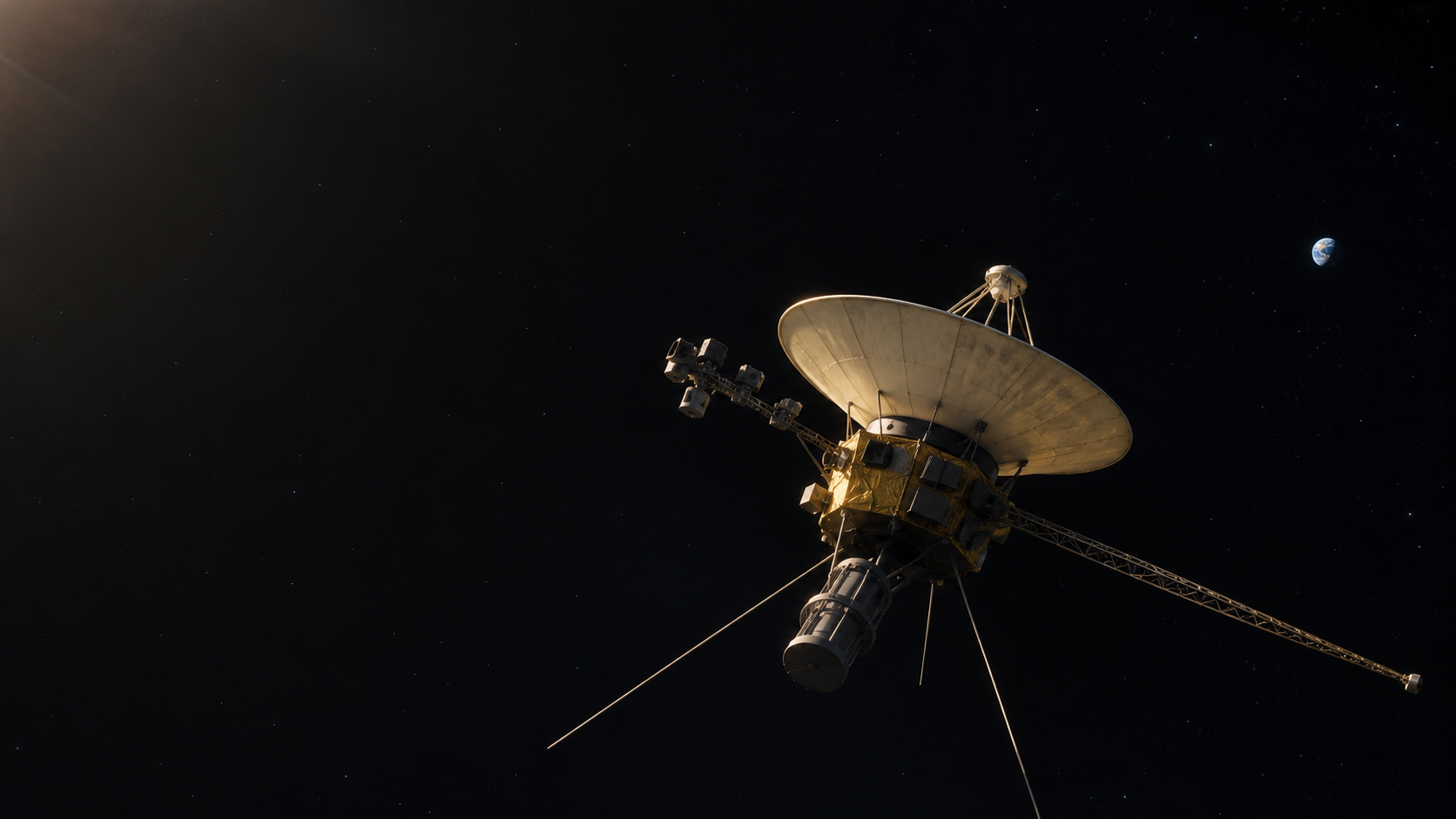 Voyager 1 Reaches a Reported One Light-Day From Earth
-
 How the Brain Represents Meaning Across Languages
-
 Renewed Rifting Detected Beneath Southern Africa
-
 Stonehenge’s Altar Stone Came From Scotland, Not Wales
-
 Earth’s New Mini-Moon 2026 QQ8: How Long Will It Stay?
-
 How to Watch the 2025 Beaver Moon Supermoon
-
 Why Russia’s Routine ISS Resupply Mission Draws Attention
-
 BepiColombo Mercury Arrival Uncertain After Software Issue
-
 Possible Second Earth-Like World Beyond Neptune
-
 2,000+ Arthropod Species Found in North American Homes
-
 Rare Triple-Star System 28 Light-Years Away
-
 BepiColombo Has Not Yet Entered Mercury’s Orbit
-
 Supermoon and the Seven Sisters: A Skywatching Guide
-
 Galactic Shock Challenges Milky Way Structure Models
-
 Jupiter’s Swirls and Colors from NASA’s Juno
-
 Fireball Streaks Over Western New York