BepiColombo Mercury Arrival Uncertain After Software Issue
BepiColombo Mercury Arrival Uncertain After Software Issue
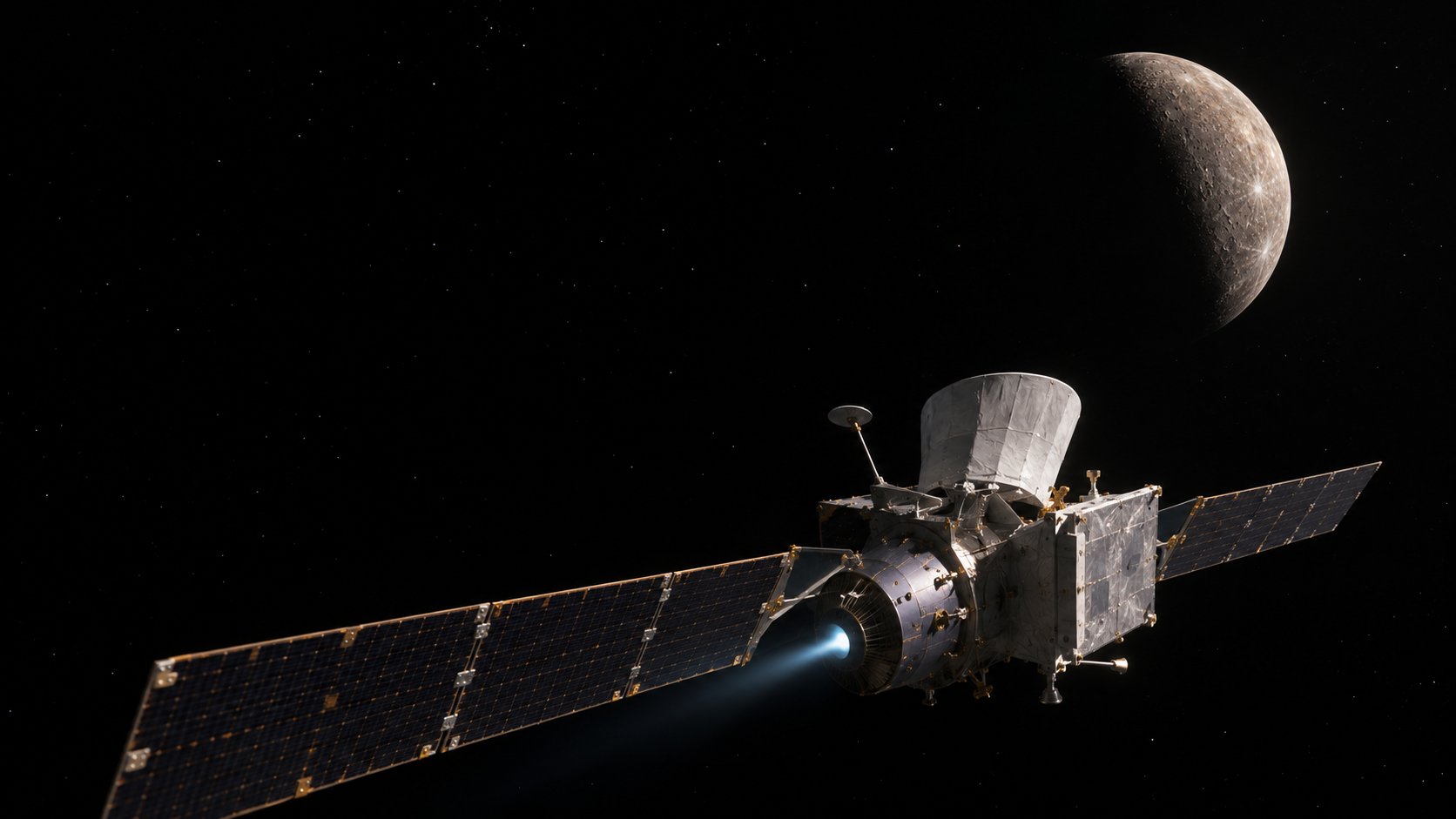
A software issue disrupted BepiColombo’s arrival at Mercury and shortened the spacecraft’s planned orbit-insertion burn. Mission controllers must now determine the spacecraft’s actual trajectory, condition and recovery options.
The incident does not automatically mean that BepiColombo has failed. A shortened burn differs from a complete propulsion failure or a confirmed loss of the mission. Engineers must first establish whether the spacecraft remains stable, connected to Earth and capable of following a correctable trajectory.
The available reporting confirms that a software-related interruption affected the maneuver and could change the spacecraft’s trajectory and operational schedule. It does not identify the exact software component involved, confirm the precise burn duration, establish the final orbit or provide an approved recovery plan. Those details require confirmation from the European Space Agency (ESA), the Japan Aerospace Exploration Agency (JAXA) and the BepiColombo mission team.
What Happened During BepiColombo’s Mercury Arrival?
A spacecraft burn is a controlled engine firing that changes its speed and trajectory. During Mercury orbit insertion, the burn is intended to place BepiColombo on a path that keeps it gravitationally bound to Mercury rather than allowing it to continue past the planet.
According to the available reports, a software issue shortened the planned orbit-insertion burn. The spacecraft may therefore have received less of the intended change in velocity. The reports do not state that the engines completely failed, nor do they confirm how much thrust was delivered.
The outcome depends on several factors, including:
- Burn duration and thrust performance.
- Spacecraft orientation during the maneuver.
- The achieved velocity change.
- The spacecraft’s position when the event occurred.
- Remaining fuel and future maneuver opportunities.
- The spacecraft’s response to any onboard safety logic.
Without those measurements, it is not possible to determine whether BepiColombo entered its intended orbit, reached a modified orbit or requires a later correction.
Why the Spacecraft’s Status Remains Unclear
Mission controllers must collect and validate telemetry before reconstructing the event. Telemetry can show whether the spacecraft maintained stable pointing, whether the propulsion system responded correctly and whether its power, communications and thermal systems remained within limits.
Navigation teams will compare spacecraft data with ground-based tracking to calculate the actual trajectory. They must also distinguish the original software event from secondary effects, such as a change in spacecraft orientation or an altered command sequence.
Key questions include:
- Did BepiColombo remain in a stable configuration?
- Did it maintain communication with Earth?
- Did the propulsion system start and stop as expected?
- Did onboard software activate a protective response?
- How much velocity change did the shortened burn produce?
- Is the resulting trajectory recoverable?
The answers may take time because anomaly analysis requires data review, trajectory reconstruction and controlled testing.
Why Mercury Orbit Insertion Is Difficult
Mercury is the closest planet to the Sun and moves rapidly around it. A spacecraft approaching Mercury must manage its speed relative to both the Sun and the planet. It must reduce its solar-orbital energy with carefully timed maneuvers before it can enter orbit.
BepiColombo’s journey relies on a long sequence of navigation operations, planetary flybys and propulsion burns. Each operation contributes to the spacecraft’s final energy and position. A deviation during one critical maneuver can affect later activities, although mission teams may have correction options.
The spacecraft also operates in an environment of intense solar radiation and heat. It must maintain strict thermal limits while preserving power, communications and accurate pointing. Communication delays prevent controllers from responding instantly to every event, so onboard software must monitor systems and respond autonomously to some conditions.
The available reports do not establish that Mercury’s environment caused the software issue. No connection to solar radiation, heat or another environmental factor should be assumed without confirmation from ESA, JAXA or the mission team.
How Software Can Interrupt a Spacecraft Maneuver
Flight software coordinates more than a simple engine command. It can manage spacecraft orientation, propulsion, sensor monitoring, power availability and safety checks during a burn.
Software may:
- Start and stop engine activity.
- Monitor propellant pressure and temperature.
- Confirm spacecraft orientation.
- Check power availability.
- Compare sensor readings with safety limits.
- Switch between autonomous and ground-directed modes.
- Place the spacecraft in a safer configuration when conditions change.
The exact BepiColombo software component involved has not been identified in the available reporting. It would be premature to blame a specific command, sensor or control module.
A fault-protection system may stop or limit a maneuver when it detects an unexpected reading or an unapproved sequence. Possible triggers include propulsion readings, attitude uncertainty, sensor values outside approved limits, power restrictions, thermal limits or a mismatch between expected and measured behavior. These are general possibilities, not confirmed explanations for this incident.
A protective shutdown can preserve spacecraft hardware while creating a navigation problem. Software issues can still produce physical consequences by stopping an engine, changing orientation or activating a safe mode.
What the Shortened Burn Could Mean
If BepiColombo did not receive the full planned velocity change, it may now be following a trajectory different from the original mission design. Controllers could recalculate the expected orbit, plan a corrective maneuver, alter the timing of later operations, adopt a modified orbit or revise the science sequence.
None of these actions should be treated as confirmed until the mission team announces them. The available sources report potential effects on trajectory and schedule, not a final recovery plan.
A trajectory correction could affect communications windows, propulsion operations, thermal planning, instrument commissioning and science observations. Recovery may delay or reprioritize scientific activities without eliminating the mission’s scientific value.
Fuel margins will be critical. Engineers must compare the required velocity correction with the spacecraft’s remaining propellant, future maneuver requirements, thrust capability and expected operating lifetime. The available reporting provides no fuel figures or correction estimates, so claims about recovery probability remain unsupported.
How Controllers Will Assess the Situation
Mission engineers will review telemetry from the propulsion, attitude-control, power, thermal, communications and onboard computer systems. They will determine whether BepiColombo is stable and able to receive commands.
Navigation teams will reconstruct the maneuver by examining engine start and stop times, thrust performance, spacecraft orientation, pressure and temperature readings and the achieved velocity change. Ground-station tracking will help refine the spacecraft’s actual path.
Once the trajectory is known, teams can model possible outcomes, including continued flight toward the intended orbit, a later correction or a modified mission profile. Each option must balance science objectives, fuel use, spacecraft health and operational risk.
Initial anomaly reports describe an event, not necessarily its final outcome. Official updates from ESA, JAXA and the BepiColombo mission team should take priority over unverified social-media claims.
BepiColombo’s Mission Context
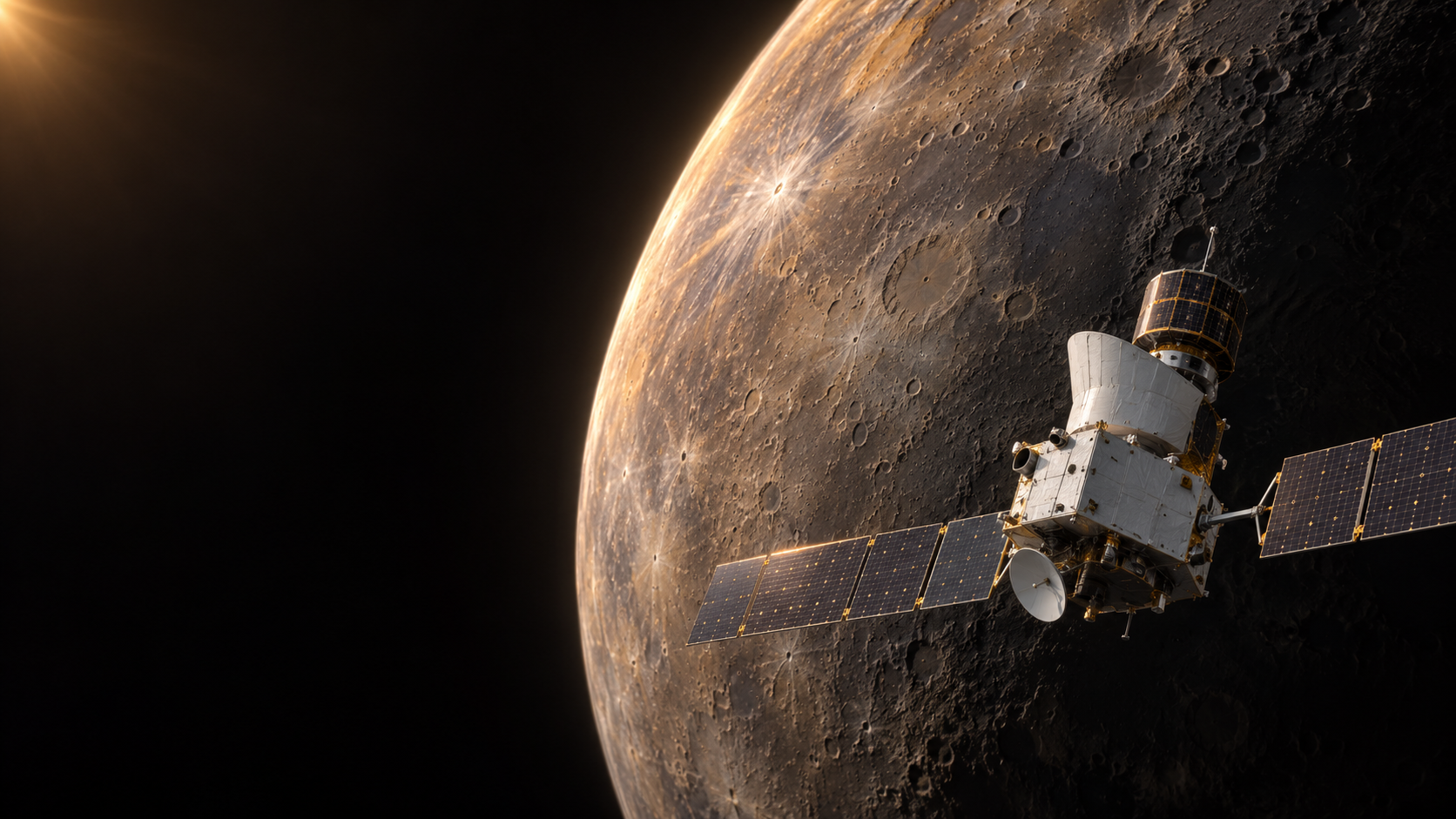
BepiColombo is a joint ESA and JAXA mission designed to study Mercury’s surface, geological history, interior structure, magnetic field, magnetosphere and thin exosphere. Its observations also support research into the planet’s formation and evolution near the Sun.
Orbit insertion matters because it enables repeated observations from changing viewing angles. A flyby provides a brief encounter, whereas an orbit allows long-term measurements of Mercury and its interaction with the solar wind.
An interrupted arrival maneuver could therefore affect more than the mission calendar. It could influence the spacecraft’s ability to conduct sustained observations, although the available reporting does not confirm damage to any instrument or a permanent loss of capability.
What Happens Next?
Mission controllers will prioritize spacecraft safety, communications and trajectory analysis. Engineers will identify the spacecraft’s configuration, review telemetry and determine whether it can continue receiving commands.
The mission team will then assess whether a corrective maneuver is practical or whether the schedule must be revised. A later burn could compensate for the shortened maneuver, but feasibility depends on the spacecraft’s velocity, position, fuel margin and system health.
Possible outcomes include:
- Recovery under a modified mission plan.
- Delayed orbit insertion or commissioning.
- Reduced or reprioritized science operations.
- More serious mission degradation if correction options are insufficient.
The available reporting does not justify selecting one outcome.
Conclusion
A software issue shortened BepiColombo’s planned Mercury orbit-insertion burn, creating uncertainty about its trajectory and schedule. The event is serious because orbit insertion depends on precise timing, orientation and velocity control.
It is not, by itself, proof that BepiColombo has failed. Engineers must confirm spacecraft health, reconstruct the maneuver, calculate the resulting trajectory and evaluate possible corrections.
Until official updates are available, the accurate description is an interrupted arrival maneuver with an uncertain trajectory, not a confirmed mission loss.
Frequently Asked Questions
What happened to BepiColombo?
A software issue affected its planned arrival maneuver at Mercury and shortened the orbit-insertion burn. The spacecraft’s trajectory and schedule remain under assessment.
Does the shortened burn mean BepiColombo has failed?
No. It confirms that the maneuver did not proceed as planned, but not that the mission has failed. Controllers must assess spacecraft health, trajectory and correction options.
Why is Mercury difficult to reach and orbit?
Mercury is close to the Sun and travels quickly around it. A spacecraft must carefully reduce its solar-orbital energy through precise navigation and multiple maneuvers.
How can software interrupt an engine burn?
Flight software monitors propulsion, power, thermal and attitude data. If a reading violates a safety condition or a sequence changes unexpectedly, protective logic may stop or shorten the maneuver.
Could BepiColombo still enter Mercury orbit?
The available reports do not confirm the final outcome. It depends on the spacecraft’s actual velocity change, trajectory, propulsion capacity and the feasibility of corrective maneuvers.
Where can readers find confirmed updates?
Readers should consult official updates from ESA, JAXA and the BepiColombo mission team for information about spacecraft health, trajectory changes and the revised schedule.
Related Articles
-
 Possible Second Earth-Like World Beyond Neptune
-
 2,000+ Arthropod Species Found in North American Homes
-
 Rare Triple-Star System 28 Light-Years Away
-
 BepiColombo Has Not Yet Entered Mercury’s Orbit
-
 Supermoon and the Seven Sisters: A Skywatching Guide
-
 Galactic Shock Challenges Milky Way Structure Models
-
 Jupiter’s Swirls and Colors from NASA’s Juno
-
 Fireball Streaks Over Western New York
-
 JWST Finds a Black Hole Outgrowing Its Galaxy
-
 A Possible Second Hidden World Beyond Planet Nine
-
 Einstein Was Right: Black Hole Image Confirms Relativity
-
 Potatoes Grow in Simulated Lunar Soil
-
 Why the Right Brain Controls the Left Body
-
 Inside SpaceX’s Starfactory: Where Starship Takes Shape
-
 BepiColombo: Europe and Japan’s Mission to Mercury
-
 Earth’s Temporary Mini-Moon: What We Know