Who Made Sydney Sweeney’s Jeans? The Labor Behind Denim
Who Made Sydney Sweeney’s Jeans? The Labor Behind Denim
Sydney Sweeney’s jeans attract attention because celebrity clothing rarely remains ordinary. A pair of denim jeans can become a fashion reference, a search trend, or a viral discussion when a widely recognized actor wears them.
But the more important question is not only which brand made the jeans. It is also: who made the garment possible?
The answer includes far more people than the celebrity wearing it. Cotton growers, spinners, dyers, weavers, pattern makers, sewing operators, laundry workers, quality inspectors, warehouse employees, and logistics workers can all contribute to a pair of jeans before it reaches a store or wardrobe.
NPR’s article, “Sydney Sweeney has great jeans. Who made them? (Psst: Workers),” uses Sweeney’s visible denim style to draw attention to the labor behind clothing. The supplied source identifies the article and its worker-focused premise, but it does not provide enough verified information to identify the jeans’ brand, factory, country of production, or individual workers.
That limitation matters. A responsible account should not invent a brand or factory. Instead, it can examine the larger story: how jeans are made, why workers remain mostly invisible, and what consumers can verify about denim production.
Why Sydney Sweeney’s Jeans Became a Story
Celebrity clothing turns familiar products into cultural objects. Jeans that might otherwise be seen as everyday clothing can attract unusual attention when they appear in a red-carpet image, paparazzi photograph, social media post, interview, or fashion campaign.
Several forces amplify that attention:
- Celebrity visibility
- Social media sharing
- Fashion search coverage
- Brand association
- Paparazzi photography
- Interest in fit, styling, and product identification
A celebrity image can make people ask where to buy a garment, how much it costs, and whether the same style is still available. Those questions are understandable, but they usually stop at the brand or retailer.
“Who made them?” asks something different. It separates the person wearing the jeans from the company selling them, the manufacturer producing them, and the workers performing the labor. A brand name may identify the marketer or retailer, but it does not necessarily identify the fabric mill, sewing factory, finishing plant, or people involved in production.
The Difference Between a Brand and a Manufacturer
Many consumers treat a clothing label as if it tells the complete story of a garment. It does not.
A brand may design a product, commission its production, purchase fabric from another company, and sell the finished item through stores or websites. Manufacturing can be handled by one or more suppliers. The denim fabric may come from a different country than the facility that cuts and sews the jeans. Washing, distressing, labeling, and packaging may occur elsewhere.
The people involved can include:
- Cotton and fiber workers
- Yarn spinners
- Textile dyeing workers
- Weaving-machine operators
- Pattern cutters
- Sewing operators
- Laundry and finishing workers
- Quality-control inspectors
- Pressing and packing staff
- Warehouse employees
- Transport and logistics workers
The supplied NPR summary supports a worker-centered framing, but it does not identify the specific people or facilities connected to Sweeney’s jeans. Naming a particular factory, wage, production country, or worker without verification would go beyond the available evidence.
How Jeans Are Made
Fiber Becomes Yarn and Fabric
Denim production begins before a garment factory receives a roll of fabric.
Traditional denim generally uses cotton, although some products include recycled fibers, elastane, or other materials. Fiber is prepared and spun into yarn. The yarn is then dyed, often with indigo or a similar colorant, before being woven into denim fabric.
These stages can involve different companies and facilities. A brand selling a pair of jeans may not own the spinning mill, dye house, or weaving operation. Fabric can travel through several parts of the supply chain before it reaches the garment manufacturer.
The denim must also meet technical requirements for weight, stretch, color, texture, and durability. Fabric specialists and quality teams assess those characteristics before production begins.
Workers Cut and Sew the Garment
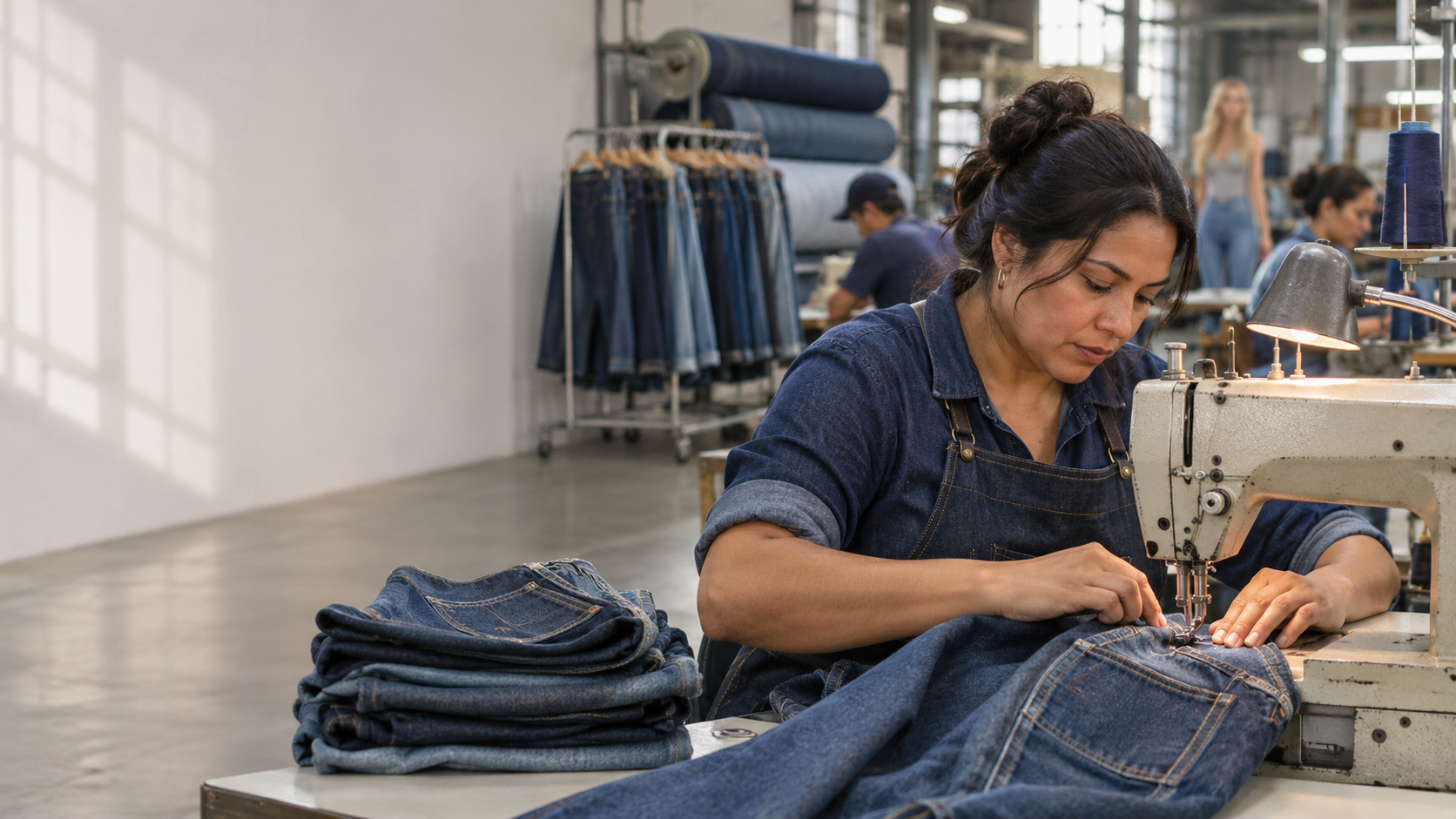
At a clothing factory, workers transform fabric into recognizable jeans. The process usually includes creating patterns, arranging them on fabric, and cutting multiple layers into panels. Workers then sew the pieces together, attaching pockets, seams, belt loops, waistbands, zippers, buttons, rivets, and brand labels.
Factories often divide the work into specialized operations. One worker may attach pockets while another closes seams or installs hardware. Although each task can appear simple to a consumer, production requires consistency, speed, concentration, and technical control.
Small errors can affect fit, strength, appearance, or comfort. Workers must repeat precise movements while meeting production targets and deadlines.
Washing Creates the Final Look
Many jeans receive additional treatment after sewing. A new pair can be washed, softened, faded, distressed, or otherwise finished to achieve a particular appearance.
Common techniques include:
- Stonewashing
- Enzyme washing
- Hand sanding
- Whiskering
- Bleaching
- Laser treatment
- Ozone processing
A faded or worn appearance is not necessarily the result of natural aging. It may require additional labor, water, chemicals, machinery, and inspection. Workers in washing and finishing facilities may handle heavy equipment, chemical processes, wet garments, noise, dust, and repetitive physical work.
Modern techniques can reduce some environmental or workplace risks, but their effects depend on the facility, equipment, safety systems, and production requirements. No specific finishing method should be attributed to Sweeney’s jeans without product documentation.
Inspection and Shipping Complete the Process
Production does not end when the final seam is sewn. Workers may inspect measurements, check stitching, trim loose threads, press the jeans, attach tags, fold the garments, and place them into packaging. Quality-control staff look for defects and confirm that products meet the brand’s specifications.
The finished jeans then move through warehouses, distribution centers, transportation networks, and retail operations. The garment’s visible story may begin with a celebrity photograph, but its production story continues through many forms of labor.
Why Garment Workers Often Remain Invisible
Consumers usually see three things:
- The celebrity wearing the garment
- The brand selling it
- The retail price
They rarely see the workers who produced it.
This distance is built into the fashion system. Marketing emphasizes fit, confidence, exclusivity, trend value, and celebrity appeal. Labor is often reduced to an abstract production cost rather than presented as the work of skilled people.
The result is a sharp contrast: Sydney Sweeney’s image may be highly visible, while the workers who cut, sewed, washed, inspected, packed, and shipped the jeans remain unidentified.
Garment production requires skill even when the work is repetitive. Sewing operators must control fabric accurately and maintain consistent stitching. Laundry workers must follow finishing specifications. Inspectors must identify faults. Warehouse staff must organize and move products quickly.
Many workers also face pressure to meet production targets. The demands can include long periods of standing or sitting, repetitive hand movements, strict deadlines, heavy equipment, and changing orders. The supplied source does not identify the conditions faced by workers connected to Sweeney’s jeans, so those conditions should not be assumed. Broader labor issues, however, remain central to understanding denim production.
Why a “Made In” Label Is Not the Whole Story
A country-of-origin label can provide useful information, but it usually describes a legally defined manufacturing stage. It may not disclose every step in the supply chain.
A label may not reveal:
- Where the cotton was grown
- Where the yarn was spun
- Where the denim was woven
- Where the fabric was dyed
- Where the jeans were washed
- Whether subcontractors were involved
- Which recruitment agencies supplied workers
- How much workers were paid
- Whether workers could raise complaints safely
Some brands publish supplier lists or manufacturing-country information. Others provide broad statements about responsible sourcing without naming facilities or explaining how results are measured.
Supply chains can also change by season, product type, color, size range, and production run. A company may use one supplier for a basic style and another for a special collection. Identifying a brand therefore does not automatically identify the workers who made one particular pair.
What Consumers Can Verify About Denim Labor
Consumers cannot determine working conditions from a celebrity photograph. They can, however, look for evidence.
Read Supply-Chain Disclosures
Useful information may include:
- Factory and supplier lists
- Manufacturing countries
- Supplier maps
- Subcontracting policies
- Worker grievance mechanisms
- Wage commitments
- Forced-labor risk policies
- Child-labor safeguards
- Audit methods and limitations
- Progress reports
A polished sustainability page is not the same as detailed transparency. Stronger disclosures identify facilities, explain standards, and report measurable progress over time.
Separate Claims From Evidence
Terms such as “responsibly made,” “conscious,” or “ethical” require clarification. Consumers can ask:
- Does the brand name the factories involved?
- Does it identify the facilities producing the denim fabric?
- Does it explain how labor claims are measured?
- Does it disclose audit limitations?
- Does it address unauthorized subcontracting?
- Does it publish wage information?
- Can workers access an independent complaint process?
A brand’s claim is not proof of a specific labor outcome. Evidence should include documentation, measurable commitments, and credible reporting.
Do Not Treat Price as Proof of Fair Pay
An expensive pair of jeans does not automatically mean workers received higher wages. The retail price can reflect branding, advertising, store costs, distribution, materials, design, scarcity, and profit margins.
A low price also does not explain the full labor story. It may reflect scale, purchasing practices, lower margins, cheaper materials, or other factors.
Wage disclosures and supplier information offer stronger evidence than price alone. The available source does not provide wage information for Sweeney’s jeans.
The Environmental Side of Denim
Denim production also raises environmental questions. Cotton cultivation, yarn preparation, dyeing, weaving, garment washing, and consumer laundering can all require water, energy, and chemicals.
The environmental impact of a specific pair depends on its materials, production methods, factory equipment, transport, product lifespan, and care. No product-specific footprint can be assigned to Sweeney’s jeans from the supplied information.
Finishing treatments can affect both environmental conditions and worker safety. Some processes involve chemical exposure, wet work, airborne dust, noise, or repetitive strain. Alternatives such as laser and ozone treatments may reduce certain impacts, but they are not automatically risk-free and cannot be assumed to have been used.
Durability also matters. Jeans that remain wearable for years may reduce demand for replacement production. Longevity depends on fabric quality, construction, fit, care, and repairability.
Buying fewer garments, choosing durable pieces, repairing damaged clothing, and considering secondhand denim can reduce consumption. These choices do not replace corporate responsibility, worker organizing, or effective regulation.
Celebrity Fashion Can Make Labor Visible
Celebrity fashion creates a useful opening for a broader conversation. A widely viewed outfit can prompt questions about a garment’s origin, manufacturing process, labor policies, and environmental effects.
That visibility alone does not improve working conditions. Better outcomes require action within the supply chain, including:
- Accurate factory disclosure
- Responsible purchasing practices
- Stable supplier relationships
- Safe grievance systems
- Worker organization
- Wage improvements
- Effective legal enforcement
- Transparency about failures and progress
Sweeney’s public visibility should not be treated as proof that she selected, endorsed, or controlled the manufacturing process. The supplied source does not establish those facts.
The central point is simple: the jeans are visible because of the person wearing them, but they exist because many workers performed the labor behind them.
What This Story Can and Cannot Confirm
Confirmed by the Supplied Source
The available source identifies an NPR article titled “Sydney Sweeney has great jeans. Who made them? (Psst: Workers),”. Its framing centers the workers behind jeans associated with Sydney Sweeney.
Not Confirmed by the Supplied Source
The available material does not establish:
- The jeans’ brand
- The exact product or style
- The production country
- The factory or factories
- The identities of the workers
- Worker wages
- Workplace conditions
- The environmental footprint
- Whether Sweeney selected, endorsed, or purchased the jeans
Any article naming those details should rely on the full NPR article, official product records, brand statements, factory documentation, or reputable labor reporting.
Frequently Asked Questions
Who made Sydney Sweeney’s jeans?
The supplied source summary does not identify the specific workers, factory, or manufacturer. The full NPR article and supporting primary sources should be reviewed before naming a facility or production country.
What brand of jeans does Sydney Sweeney wear?
The available source summary does not provide a verified brand or product name. A reliable identification should come from the full article, a documented outfit source, or an official brand statement.
Why does it matter who made a pair of jeans?
Workers may face issues involving wages, production targets, workplace safety, chemical exposure, repetitive strain, and job security. Asking who made the garment places labor inside a conversation that often focuses only on celebrity and style.
What should a transparent denim brand publish?
Useful disclosures include supplier and factory names, manufacturing countries, production processes, labor standards, grievance mechanisms, audit limitations, wage commitments, and measurable progress.
Does a high-priced pair of jeans guarantee fair pay?
No. Retail price does not show how much workers earned or whether they received a living wage. Wage policies, supplier disclosures, and credible labor reporting provide stronger evidence.
How can consumers support better denim production?
Research brand disclosures, ask specific supply-chain questions, choose durable garments, repair clothing, consider secondhand options, and support worker-rights organizations. Consumer action helps, but it does not replace corporate and regulatory accountability.
A Great Pair of Jeans Has a Human Story
Sydney Sweeney’s jeans draw attention to the final, visible stage of fashion. The larger story begins much earlier, with the people who grow or process fibers, make yarn, weave and dye fabric, cut panels, sew seams, apply finishes, inspect garments, manage warehouses, and move products around the world.
The available source does not identify exactly who made Sweeney’s jeans. It does establish a more important question: why do consumers know the celebrity wearing a garment but rarely know the workers who produced it?
Asking “Who made them?” changes the conversation from fashion spectacle to labor accountability. The strongest answer will not come from a celebrity image, a high price, or vague ethical language. It will come from specific supply-chain evidence.
Artikel Terkait
-
 Trump Tests Political Strength at Xi and Putin Summit
-
 Miguel Ángel Félix Gallardo: What Is Confirmed
-
 Who Makes Sydney Sweeney’s American Eagle Jeans?
-
 Jordan Sentences Three Men to Death After Church Attack
-
 Sean Duffy Blames Congress for FAA Air Travel Chaos
-
 Why US Colleges Are Losing International Students