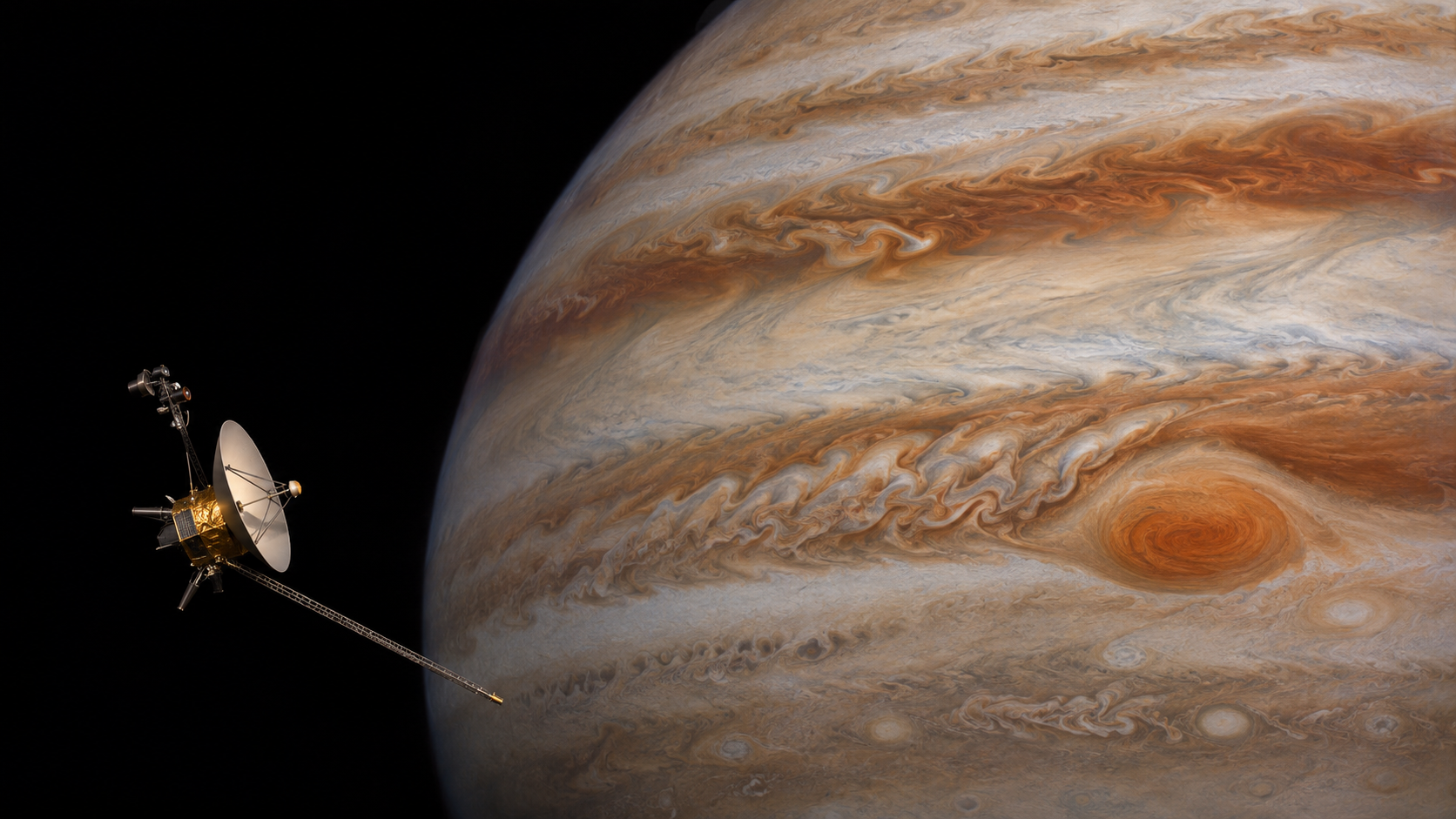
Voyager 1: Humanity’s Farthest Spacecraft
Voyager 1: Humanity’s Farthest Spacecraft
Voyager 1 is the most distant human-made object from Earth. Launched in 1977 to study Jupiter and Saturn, the spacecraft continued far beyond its original mission and became humanity’s first operating probe in interstellar space.
Its achievement is measured in more than distance. Voyager 1 has survived for more than four decades, crossed the outer Solar System, returned data from beyond the heliosphere, and continued communicating across a gap that grows larger every day.
Voyager 1 is not necessarily the fastest object humans have launched. Some probes have reached higher speeds relative to the Sun. Voyager 1 holds the distance record because it has spent decades traveling outward on an escape trajectory. Its distance from Earth and the Sun continues to increase.
The spacecraft’s journey reflects a combination of planetary gravity assists, durable engineering, careful power management, and persistent human control from Earth.
Voyager 1’s Record-Breaking Distance
How Far Away Is Voyager 1?
Voyager 1’s distance changes continuously. Earth orbits the Sun, Voyager 1 moves away from the Sun, and the spacecraft’s position changes relative to both bodies. A precise distance must therefore include a date and reference point.
Scientists commonly describe deep-space distances in astronomical units, or AU. One astronomical unit is the average distance between Earth and the Sun, approximately 150 million kilometers. Voyager 1 is more than 160 AU from Earth and the Sun, although the exact value changes with time. NASA’s Voyager 1 mission page provides updated distance and communication information.
Another useful measure is light-time. Radio signals travel at the speed of light, but even light needs many hours to cross the distance between Earth and Voyager 1. A command sent from Earth cannot produce an immediate response. Engineers must account for this delay when planning instructions, diagnosing faults, and requesting scientific data.
Voyager 1 Compared With Other Spacecraft
Voyager 1 is farther from Earth than Voyager 2, New Horizons, Pioneer 10, and every spacecraft operating near Earth or the planets. Voyager 2 also traveled through the outer Solar System and entered interstellar space, but its trajectory places it closer to Earth than Voyager 1.
New Horizons crossed Pluto’s system and continues outward, yet it launched later and has not had as much time to accumulate distance. Pioneer 10, launched in 1972, was once the most distant active human-made object, but Voyager 1 eventually surpassed it.
Distance and speed are different measurements. Solar-probe missions can reach extraordinary speeds while remaining much closer to the Sun. Voyager 1’s record comes from its long journey, outward trajectory, and gravitational boosts during planetary encounters.
Why Voyager 1 Keeps Moving Away
Voyager 1 is traveling on an escape trajectory rather than a closed orbit around the Sun. After its encounters with the outer planets, its speed and direction carried it permanently outward.
The spacecraft is not using a conventional rocket engine to accelerate continuously. Its current motion mainly reflects the velocity it gained during its planetary journey and the gravitational forces that shaped its path. With no significant atmosphere or drag in deep space, Voyager 1 can continue coasting for an immense period.
Voyager 1 remains gravitationally connected to the Milky Way, but it is leaving the Sun’s neighborhood. Its future path will carry it through the space between stars rather than toward a near-term destination.
The 1977 Launch and Planetary Mission
Voyager 1’s Original Purpose
Voyager 1 was designed primarily as a planetary explorer. Its mission focused on Jupiter and Saturn, including their atmospheres, magnetic fields, radiation environments, rings, and moons.
The spacecraft launched from Cape Canaveral on September 5, 1977. Voyager 2 launched earlier, on August 20, but Voyager 1 followed a faster trajectory and reached Jupiter first. The two missions formed part of a broader effort to examine the outer planets at close range.
Voyager 1 did not need to be designed as a conventional interstellar probe. Its initial objectives involved two planetary encounters. Its later role emerged because the spacecraft survived, performed well, and followed a trajectory that allowed the mission to continue beyond Saturn.
The Rare Planetary Alignment
Voyager’s route depended on a favorable alignment of the outer planets. This alignment allowed the spacecraft to use gravity assists, a technique that changes a probe’s speed and direction during a close planetary flyby.
A spacecraft passes near a moving planet and interacts with the planet’s gravity. The maneuver can redirect the spacecraft and increase its speed relative to the Sun without requiring a large onboard rocket burn. The planet loses an extremely small amount of orbital energy, while the spacecraft gains the energy needed for a more distant trajectory.
This technique made it possible for Voyager to reach the outer Solar System with limited fuel. It also demonstrated why planetary positions can influence space-exploration plans for decades.
Jupiter and Saturn
Voyager 1 reached Jupiter in 1979. Its instruments examined the giant planet’s atmosphere, cloud bands, magnetic field, radiation belts, and major moons. The mission produced detailed observations of Jupiter’s turbulent weather and powerful magnetosphere.
One of the most important discoveries involved Io, Jupiter’s innermost large moon. Voyager images revealed active volcanoes erupting on its surface. Io became the first world beyond Earth known to have active volcanoes, changing scientific understanding of moons and planetary geology NASA Jet Propulsion Laboratory.
Voyager 1 reached Saturn in 1980. It studied Saturn’s atmosphere, rings, magnetic environment, and moons. The spacecraft also observed Titan, Saturn’s largest moon, which has a dense atmosphere rich in nitrogen and complex carbon compounds.
The Saturn encounter determined Voyager 1’s later trajectory. A close approach to Titan sent the spacecraft onto a path that prevented it from continuing to Uranus and Neptune. Voyager 2 took the alternative route and became the only spacecraft to visit all four outer planets: Jupiter, Saturn, Uranus, and Neptune.
For Voyager 1, the Titan flyby marked the end of its primary planetary tour and the beginning of a much longer journey outward.
From Planetary Explorer to Interstellar Mission
Unexpected Longevity
Voyager 1 continued operating after completing its main planetary objectives because the spacecraft remained functional and its instruments continued to produce valuable data. NASA extended the mission rather than treating the Saturn encounter as its endpoint.
Several factors supported its longevity:
- Durable spacecraft engineering.
- Conservative use of electrical power.
- Redundant systems.
- Remote troubleshooting by ground teams.
- Adaptable software and command procedures.
- Selective shutdown of instruments and heaters.
Voyager 1 was built with 1970s hardware, but its mission has depended on ongoing human work. Engineers have interpreted old documentation, preserved aging systems, developed new procedures, and solved problems without physical access to the spacecraft.
The mission demonstrates that spacecraft life depends not only on original design but also on the ability of Earth-based teams to manage decline, prioritize functions, and find unconventional solutions.
Entering Interstellar Space
The heliosphere is the enormous region influenced by the solar wind and the Sun’s magnetic field. The solar wind consists of charged particles flowing outward from the Sun, forming a protective bubble within interstellar space.
The heliopause marks the outer boundary of that bubble. Beyond it, the solar wind no longer dominates the surrounding environment. Voyager 1 crossed the heliopause in 2012, according to NASA’s interpretation of its measurements NASA.
“Interstellar space” does not mean Voyager 1 has reached another star system. The spacecraft remains extremely far from the nearest stars and is still traveling through the Milky Way. The term means that Voyager 1 is outside the heliosphere, in the space between the Sun’s influence and the surrounding interstellar medium.
Its crossing began a new phase of exploration. Voyager 1 moved from studying planets and their immediate environments to measuring the boundary between the Solar System and interstellar space.
What Voyager 1 Measures
Voyager 1 carries instruments that measure magnetic fields, charged particles, cosmic rays, plasma waves, and other features of its environment. These observations help scientists study how the solar wind interacts with interstellar material.
The data can reveal:
- The behavior of magnetic fields beyond the heliopause.
- The movement and energy of charged particles.
- Conditions in the outer heliosphere.
- The relationship between solar and interstellar particles.
- Plasma waves and disturbances in the space between stars.
Voyager 1’s scientific importance therefore extends beyond its distance record. It has provided direct measurements from a region no other operating spacecraft had reached before, helping researchers understand the structure of the heliosphere and how stellar environments interact with interstellar space.
How Voyager 1 Communicates With Earth
The Deep Space Network
Voyager 1 communicates through a radio system supported by NASA’s Deep Space Network. The network uses large antennas in California, Spain, and Australia to send commands, receive data, and track spacecraft across the Solar System NASA Deep Space Network.
At Voyager 1’s distance, the signal arriving at Earth is extremely weak. Ground antennas must point precisely toward the spacecraft and use sensitive receivers to identify the transmission. The network also tracks the spacecraft’s position and movement, helping controllers maintain communication.
Radio signals weaken as they spread across space. Data transmission becomes slow, and commands take many hours to reach the spacecraft. Responses take many more hours to return. Engineers cannot operate Voyager 1 through real-time control.
The Meaning of Its Radio Signal
Receiving a signal is not the same as receiving a large amount of useful data. Voyager 1 may transmit a faint carrier signal that confirms its radio system is operating, while scientific data requires a separate, slower transmission process.
A command must be carefully designed, checked, and sent. Engineers then wait for the signal to reach Voyager 1, for the spacecraft to process the instruction, and for the response to travel back to Earth. Troubleshooting can take days or longer.
This delay requires procedures that tolerate uncertainty. Teams must consider possible outcomes before sending a command and prepare follow-up instructions for different results. A small mistake cannot be corrected instantly.
Technical Challenges
Maintaining a spacecraft launched in 1977 presents several risks. Computer memory can degrade. Electrical power becomes increasingly limited. Instruments and heaters may stop operating. Communication faults can corrupt data or prevent normal commands from working.
Voyager 1’s computers have extremely limited memory and processing capacity by modern standards. Engineers must develop procedures that fit within those constraints and remain compatible with decades-old systems.
When problems occur, mission teams may rewrite commands, change operating procedures, or repurpose remaining systems. They must also protect essential functions, including communication, attitude control, power distribution, and thermal stability.
Voyager 1 has experienced periods when its communications or data systems produced incorrect information. Engineers have sometimes restored useful operations through remote diagnosis and carefully transmitted code or commands. Each recovery reflects both the spacecraft’s resilience and the expertise of the teams maintaining it.
Power, Temperature, and Remaining Life
Radioisotope Power
Voyager 1 does not rely on solar panels for its primary electricity. At the distance of the outer planets and beyond, sunlight is too weak for solar arrays to provide practical power.
Instead, Voyager 1 uses radioisotope thermoelectric generators, or RTGs. These devices produce electricity from heat released by the radioactive decay of plutonium-238. The process requires no moving parts, but available heat and electrical output decline gradually over time NASA Jet Propulsion Laboratory.
The declining power supply limits the mission. Controllers must turn off instruments, heaters, and other systems as necessary. Every shutdown involves a trade-off between scientific value, communication, thermal control, and long-term survival.
Prioritizing Essential Systems
Mission controllers prioritize functions that protect the spacecraft and preserve the most valuable science. Communication hardware must remain available, and the spacecraft must maintain enough thermal control to prevent critical components from becoming too cold.
The likely pattern is gradual reduction rather than immediate failure. Voyager 1 may continue transmitting with fewer instruments, lower data rates, and stricter operating schedules. This approach maximizes the remaining scientific return while protecting essential systems.
When Communication Will End
No precise end date should be treated as permanent without a current NASA mission update. Voyager 1’s remaining life depends on power output, system health, thermal conditions, and future engineering decisions.
Communication may end when available electrical power can no longer support the transmitter or the systems needed to operate it. It could also end if critical hardware fails or the spacecraft cannot maintain safe temperatures.
The end of communication will not be the end of Voyager 1’s movement. The spacecraft will continue coasting through space after its instruments and transmitter shut down.
Why Voyager 1 Matters
An Engineering Achievement
Voyager 1 demonstrates the value of conservative design and graceful degradation. A spacecraft that cannot be physically repaired must be able to survive partial failures, reduced power, and changing mission priorities.
Its longevity reflects:
- Redundant hardware.
- Careful energy management.
- Durable components.
- Flexible command procedures.
- Detailed technical records.
- Ground teams capable of solving unfamiliar problems.
These lessons influence modern deep-space missions. Future probes may use faster computers and more advanced instruments, but they will still face power limits, communication delays, radiation, and the difficulty of operating beyond direct human reach.
A Scientific Legacy
Voyager 1 changed knowledge of Jupiter and Saturn. Its observations contributed to understanding giant-planet atmospheres, powerful magnetic fields, complex ring systems, and active moons.
The discovery of volcanoes on Io showed that moons can remain geologically active. Its observations of Titan helped establish that the moon possesses a dense atmosphere and contributed to the foundation for later missions such as Cassini-Huygens.
Beyond the planets, Voyager 1 opened direct study of the heliopause and interstellar space. Its measurements showed that the outer boundary of the Sun’s influence is an active scientific environment, not a simple invisible line.
The Human Meaning of an Uncrewed Journey
Voyager 1 is a small machine compared with the region it has crossed. Yet it has carried human instruments, calculations, commands, and scientific questions farther than any crewed vehicle or other human-made object.
Its continued outward motion creates a powerful contrast. The people who built and launched it have aged, retired, or died, while the spacecraft continues to travel. Its signal connects generations of engineers and scientists to a place no human has visited.
Voyager 1 is not a substitute for human exploration. It is evidence that human curiosity can extend beyond direct physical presence through machines designed to observe, measure, and endure.
The Future of Deep-Space Exploration
Voyager 1 offers practical lessons for future probes traveling beyond the heliosphere:
- Design systems that can lose functions without losing the entire mission.
- Build flexible software and command procedures.
- Plan for declining power from the beginning.
- Protect communication systems as a top priority.
- Include instruments that can operate across changing environments.
- Preserve detailed engineering documentation for future teams.
A replacement mission would require decades to reach a comparable distance. It would also require a powerful launch vehicle, specialized instruments, long-term operations funding, and a communication system capable of detecting extremely weak signals.
New spacecraft could be technologically superior without being farther away. Technology and accumulated distance are separate advantages. A modern probe might collect more data near the Sun or another planet, but it cannot instantly match Voyager 1’s position.
Voyager 1 will continue moving away from the Sun regardless of when its signal fades. It will not reach another star in the foreseeable future. Its achievement is not only where it is, but also the fact that a machine launched in 1977 remained part of humanity’s scientific reach for so long.
Conclusion
Voyager 1 is the farthest human-made object from Earth. Its journey began with a 1977 launch and a mission to study Jupiter and Saturn. Gravity assists carried it through the outer Solar System, and a successful planetary mission became a decades-long exploration of the heliosphere and interstellar space.
Scientifically, Voyager 1 delivered observations of giant planets, moons, magnetic fields, particles, and the boundary of the Sun’s influence. Technically, it showed how careful engineering and persistent operations can keep an aging machine working across extraordinary distances.
Eventually, Voyager 1 will stop communicating. Its power will decline, its systems will shut down, and its scientific data will end. Its movement will not. The spacecraft will continue drifting outward, carrying the history of its mission into a future far beyond the period when Earth can hear from it.
Frequently Asked Questions
How far away is Voyager 1?
Voyager 1 is more than 160 astronomical units from Earth and the Sun, but its exact distance changes continuously. NASA provides updated mission information through its Voyager mission page.
Is Voyager 1 in interstellar space?
Yes. Voyager 1 crossed the heliopause in 2012 and is traveling through interstellar space. This does not mean it has reached another star system or left the Milky Way. It means the spacecraft is outside the heliosphere, the region dominated by the solar wind.
Is Voyager 1 still working?
Voyager 1 has continued operating far beyond its original planetary mission. Its power supply is declining, and some instruments and systems have been turned off or may no longer function. The latest NASA mission update provides the most reliable status.
What is farther away, Voyager 1 or Voyager 2?
Voyager 1 is farther from Earth than Voyager 2. Both spacecraft are traveling outward on different trajectories, and their distances from Earth and the Sun change over time.
How does Voyager 1 send data back to Earth?
Voyager 1 uses a radio communications system supported by NASA’s Deep Space Network. Large ground antennas receive its weak signal, send commands, and track the spacecraft. The great distance creates long communication delays and limits the amount of data it can transmit.
What will happen when Voyager 1 runs out of power?
Voyager 1 will eventually stop communicating and transmitting scientific data when its power or critical systems become insufficient. It will not stop moving immediately. After its systems shut down, the spacecraft will continue drifting through interstellar space.