Trump’s Reported Pete Rose Pardon Reopens MLB Debate
Trump’s Reported Pete Rose Pardon Reopens MLB’s Biggest Integrity Debate
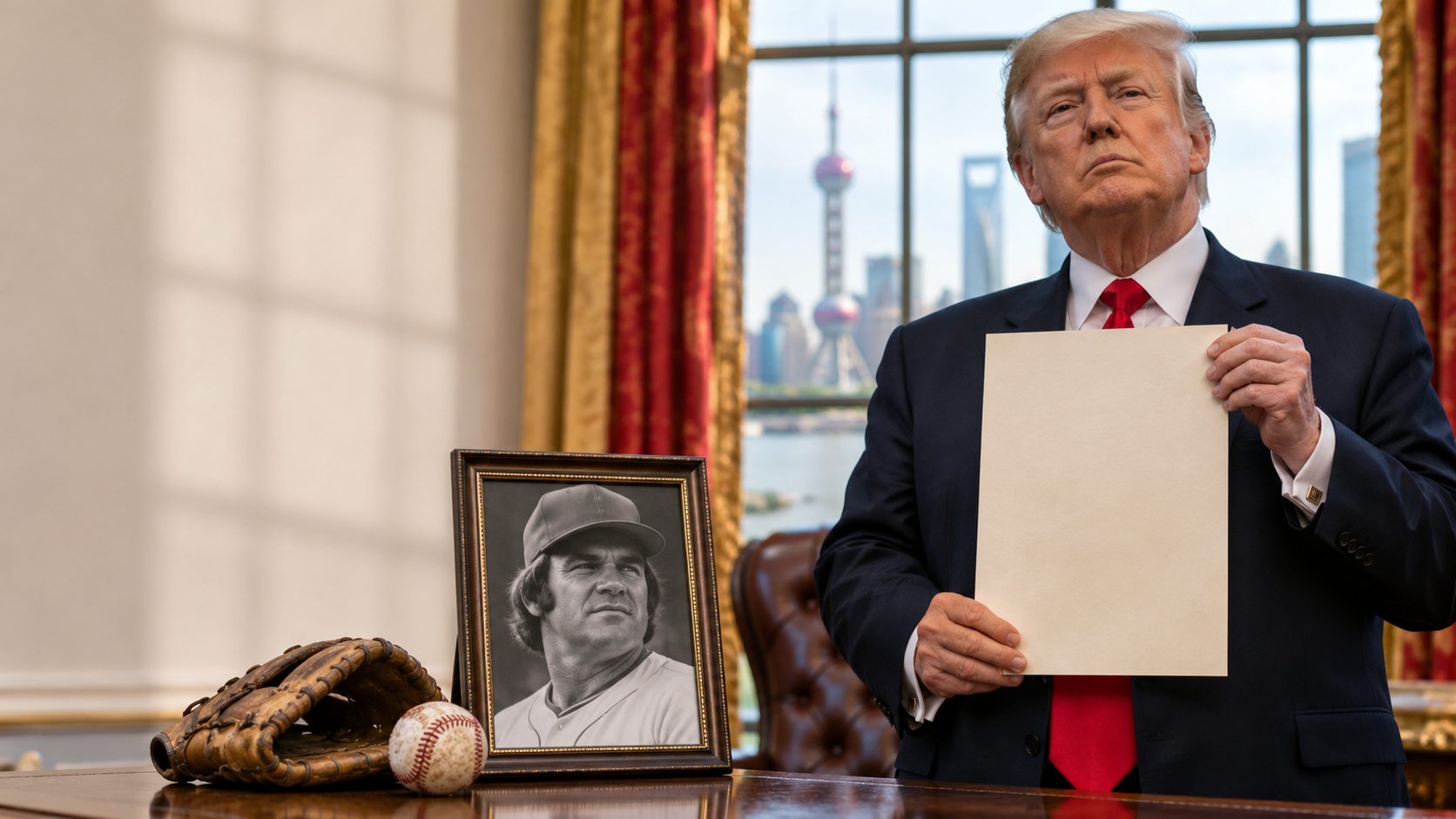
President Donald Trump reportedly granted Pete Rose a posthumous pardon, renewing debate over the legacy of Major League Baseball’s all-time career hits leader, his gambling-related lifetime ban, and his exclusion from the Baseball Hall of Fame.
Reports from NBC News, The Inquirer, ABC News, the Washington Examiner, and NewsCord describe the action as a presidential pardon issued after Rose’s death. However, the supplied reports do not include the official pardon document or identify the precise federal offenses covered. Those details should be confirmed through official White House, Department of Justice, or federal records.
The reported pardon matters because Rose’s baseball punishment came from MLB, while a presidential pardon generally concerns federal criminal offenses. These are separate systems. Clemency does not automatically restore MLB eligibility, remove a player from baseball’s permanently ineligible list, or guarantee entry into Cooperstown.
What the Reported Pardon Means
A presidential pardon has limited legal scope
A presidential pardon generally applies to federal offenses. It can forgive or lessen the consequences of covered federal criminal conduct, but it does not give the president authority over every private or institutional penalty imposed by another organization.
A pardon does not automatically:
- Restore Rose’s eligibility to participate in MLB activities.
- Remove his name from MLB’s permanently ineligible list.
- Reverse baseball’s disciplinary findings.
- Make him eligible for Hall of Fame consideration.
- Change the official validity of his career statistics.
- Erase the historical record surrounding his gambling controversy.
NewsCord characterized the reported action as a “complete and total pardon.” The final legal interpretation depends on the wording of the official document and the offenses it covers.
Why the pardon is described as posthumous
A posthumous pardon is granted after the recipient’s death. It cannot provide personal relief, but it can carry symbolic importance for family members, supporters, and the public.
Rose died on September 30, 2024, at age 83. A posthumous pardon cannot restore his career or allow him to return to the ballpark. It can influence how the public discusses his federal case and intensify demands for baseball institutions to reconsider his status.
The distinction remains important: a posthumous pardon may address criminal liability or public reputation, but it does not automatically rewrite a sports organization’s disciplinary history.
What remains unclear
The current reports leave several questions unresolved:
- When exactly was the pardon announced?
- What was Rose’s full legal name in the document?
- Which federal offenses were covered?
- Was the pardon full or limited?
- Did MLB formally change Rose’s status?
- Did the Baseball Hall of Fame alter its eligibility rules?
- Did the White House publish a legal rationale?
The official document should control the final interpretation. News summaries can establish that a report was made, but they cannot replace the underlying presidential record.
Who Was Pete Rose?
Pete Rose was one of the most productive and recognizable players in baseball history. Known as “Charlie Hustle,” he built his reputation on durability, aggressive baserunning, constant effort, and an unusually consistent ability to reach base safely.
Rose played primarily for the Cincinnati Reds and later appeared for the Philadelphia Phillies and Montreal Expos. He became closely associated with Cincinnati’s dominant teams of the 1970s and helped the Reds win multiple World Series championships. He also won National League Most Valuable Player recognition and earned numerous All-Star selections.
His career combined extraordinary production with a controversial ending. Rose became a symbol of both baseball excellence and baseball gambling. That tension explains why the reported pardon remains controversial decades after his playing career ended.
Rose’s record as MLB’s all-time hits leader
Rose finished his career with 4,256 hits, the highest total in MLB history. The record remains one of baseball’s most significant statistical achievements.
Accumulating that many hits requires a long career, consistent health, strong contact skills, and sustained performance against changing pitchers and defensive strategies. Rose’s record surpassed Ty Cobb’s previous career mark and became the defining statistic of his career.
The record does not depend on Hall of Fame voting or the resolution of Rose’s disciplinary status. Baseball’s statistical records and institutional honors are separate matters. The reported pardon does not change the number of hits Rose recorded, nor does it determine whether baseball should officially celebrate him as one of the sport’s historical greats.
Major career milestones
Rose’s accomplishments included his emergence as a star with the Cincinnati Reds, his central role on the “Big Red Machine,” and his later success with the Philadelphia Phillies. He also played for Montreal before returning to Cincinnati as a player-manager.
His career highlights included:
- 4,256 career hits.
- Multiple All-Star selections.
- National League Most Valuable Player recognition.
- Three World Series championships.
- A World Series Most Valuable Player Award.
- MLB’s career hits record.
- More than two decades as a professional player.
These achievements explain why many supporters believe Rose belongs in the Baseball Hall of Fame. Critics generally do not dispute his statistical accomplishments. Their objection concerns whether his conduct violated baseball’s most important competitive-integrity standards.
Why Pete Rose Was Banned From Baseball
Gambling allegations and the MLB investigation
Rose faced allegations that he gambled on baseball games while serving as a player and manager. MLB investigated the allegations, and Rose accepted placement on the permanently ineligible list in 1989.
The controversy involved questions about betting on baseball and whether Rose placed wagers on games involving the Cincinnati Reds, the team he managed. The details of individual bets and the evidence surrounding them have remained subjects of public debate, but the institutional concern was clear: baseball views gambling by players and managers as a threat to competitive integrity.
Baseball has historically treated betting on the sport more severely than ordinary personal misconduct because gambling can create conflicts of interest. A manager’s decisions affect pitching changes, lineups, substitutions, and strategy. Even the appearance that those decisions could be influenced by wagers can damage confidence in the competition.
Rose’s lifetime ban
Rose accepted permanent placement on MLB’s permanently ineligible list. The agreement imposed severe professional consequences and effectively prevented him from official participation in baseball. It also blocked normal consideration for the sport’s highest honors while he remained on the list.
The lifetime ban was an MLB disciplinary action, not a sentence imposed by a criminal court. A presidential pardon may address federal criminal conduct, but it does not automatically reverse an MLB agreement.
A pardon is not the same as an MLB reinstatement, and MLB reinstatement is not the same as Hall of Fame induction.
Baseball discipline and criminal conduct are separate
MLB can discipline a player under its rules even when criminal prosecutors do not bring charges or when a criminal case concerns different conduct. A federal pardon also does not establish that the recipient committed no misconduct. It provides executive clemency for covered federal offenses, and its effect depends on the document’s wording.
That separation is central to understanding the reported Trump-Pete Rose pardon controversy.
Does the Pardon Remove Rose’s MLB Lifetime Ban?
MLB controls its own eligibility decisions
A presidential pardon cannot force MLB to remove Rose from its permanently ineligible list. MLB controls its disciplinary and eligibility processes. The commissioner’s office could independently review Rose’s status, but any change would require an MLB decision.
MLB could separately determine whether Rose may:
- Participate in official baseball activities.
- Attend team events in an official capacity.
- Hold a coaching or managerial position.
- Receive formal recognition from the league.
- Appear in team or league promotional materials.
The consequences would depend on MLB’s rules and any conditions attached to a new decision.
The reported reinstatement claim
ABC News reportedly connected the pardon with MLB reinstating Rose, describing the action as occurring after the league reinstated the career hits leader. That claim requires confirmation through an MLB announcement, an updated ineligible list, or a direct statement from the commissioner’s office.
The supplied material does not provide the date, terms, conditions, or legal basis of any reinstatement. Until MLB publishes an official position, the reported pardon and reported reinstatement should be treated as related but separately verified developments.
The Baseball Hall of Fame Question
Rose remained outside Cooperstown because players on MLB’s permanently ineligible list were not eligible for normal Hall of Fame consideration. The Hall of Fame and MLB are separate institutions, although the Hall’s eligibility rules have historically depended on baseball’s ineligible list.
A pardon does not automatically create Hall of Fame eligibility. Several questions must be answered first:
- Did MLB remove Rose from the permanently ineligible list?
- Did the Hall of Fame change its rules?
- Which voting body would consider Rose?
- Would any eligibility decision apply immediately or in a future election cycle?
- Would the Hall evaluate his playing record separately from his gambling conduct?
Arguments from Rose’s supporters
Rose’s supporters argue that his playing record is too significant to exclude from baseball’s highest honor. They point to his hits record, championships, durability, and importance to the Cincinnati Reds and Philadelphia Phillies.
Supporters may also argue that the punishment was excessive, that Rose’s statistical accomplishments should be evaluated separately, and that other baseball figures involved in serious misconduct received different treatment. They may view the posthumous pardon as recognition of the importance of his career.
Arguments from Rose’s critics
Critics argue that gambling on baseball threatens the sport’s foundation. Baseball depends on fans believing that players, managers, and officials make decisions for competitive reasons rather than financial ones.
Critics may contend that betting on baseball creates an unacceptable conflict of interest, that a lifetime ban remains necessary as a deterrent, and that Hall of Fame induction could weaken anti-gambling standards. In their view, exceptional statistics cannot override rules intended to protect competition.
The disagreement therefore concerns more than one player. It concerns whether baseball can honor extraordinary performance without weakening the rules that protect competitive trust.
Political and Cultural Significance
The reported pardon is also a political and cultural statement. Rose remained popular among many baseball fans, especially in Cincinnati and Philadelphia. His name carries strong emotional associations with an era when gambling was treated as a particularly serious threat to professional sports.
The action may appeal to people who view Rose’s punishment as excessive or incomplete. It may also anger those who believe the lifetime ban was essential to preserve baseball’s credibility.
No motive should be assigned without direct evidence. The symbolic impact, however, is clear: the pardon places Rose’s unfinished legacy back at the center of national discussion.
Baseball’s changing gambling environment
The sports betting environment has changed significantly since Rose’s ban. Legal wagering is now widely available in many jurisdictions, and professional leagues often partner with betting companies.
That change does not necessarily make betting by players or managers acceptable. Public betting and insider betting are different issues, as are wagers on unrelated games and bets involving one’s own team.
Modern integrity rules commonly restrict players, coaches, managers, officials, and other personnel from betting on their sport. Legalized public wagering can increase the need for strict safeguards because more money and betting information circulate through the system.
Rose’s case remains relevant because it tests whether baseball’s standards should evolve with the betting market or remain deliberately strict.
What Happens Next?
The next stage involves verification rather than speculation.
Confirm the presidential action
The official record should establish:
- Rose’s legal identity.
- The announcement date.
- The offenses covered.
- Whether the pardon was full or limited.
- Whether it was issued after his death.
- The legal reasoning, if provided.
Confirm MLB’s position
MLB’s official records should show whether Rose’s status changed. A reliable update should identify the date of any reinstatement, the authority making the decision, any conditions imposed, and whether the decision affects coaching, managerial, ceremonial, or Hall of Fame eligibility.
Reassess the Hall of Fame issue
Even if MLB reinstated Rose, the Hall of Fame would still need to apply its own rules. Possible outcomes include a rules review, renewed eligibility debate, public campaigns, or continued exclusion.
The pardon may change the conversation without resolving it.
Conclusion
The reported Trump posthumous pardon of Pete Rose brings renewed attention to one of baseball’s most accomplished and controversial figures. Rose remains MLB’s all-time career hits leader with 4,256 hits, a World Series champion, a Cincinnati Reds icon, and a former Philadelphia Phillies star.
He also remains associated with gambling-related misconduct and a lifetime ban from baseball. Those facts coexist. The pardon does not erase Rose’s statistics, and the statistics do not erase the integrity concerns that produced the ban.
Presidential clemency, MLB reinstatement, and Baseball Hall of Fame induction are separate questions. The official pardon document and MLB records must determine what changed legally and institutionally.
The broader debate is whether baseball can honor exceptional performance while preserving strict standards against conduct that threatens competitive trust. Rose’s legacy remains unresolved because both sides of that question are central to the sport’s history.
Frequently Asked Questions
What did Trump’s posthumous pardon of Pete Rose do?
Reports state that Donald Trump granted Rose presidential clemency after Rose’s death. The precise legal effect depends on the official pardon document and the federal offenses it covers. The action does not automatically remove MLB discipline or guarantee Hall of Fame eligibility.
Why was Pete Rose banned from Major League Baseball?
Rose accepted placement on MLB’s permanently ineligible list after an investigation into gambling-related conduct. The ban was imposed by baseball authorities and was separate from any criminal court judgment.
Was Pete Rose reinstated by MLB?
ABC News reported that Rose was reinstated before the pardon, but the supplied material does not include an official MLB announcement or the terms of any reinstatement. MLB records should confirm the claim.
Is Pete Rose eligible for the Baseball Hall of Fame now?
Not automatically. Eligibility depends on MLB’s ineligible-list status and the Hall of Fame’s rules. A presidential pardon alone does not create Hall of Fame eligibility or guarantee induction.
How many hits did Pete Rose have?
Pete Rose recorded 4,256 career hits, the most in MLB history. That statistical record remains unchanged by his disciplinary status or the reported pardon.
Why is the Rose pardon controversial?
The controversy reflects competing views about Rose’s achievements, baseball’s gambling rules, the meaning of posthumous clemency, and the authority of MLB and the Hall of Fame. Supporters emphasize his historic career. Critics emphasize competitive integrity and strict anti-gambling standards.
Related Articles
-
 Can Puka Nacua Serve a Suspension on Injured Reserve?
-
 RJ Luis Jr. and the NIL Era’s Biggest ‘Bag Fumble’
-
 How the Vikings Prepared for Mexico City’s Elevation
-
 UFC Fight Night 294 Weigh-In Results: One Misses Weight
-
 Puka Nacua Suspended Three Games by NFL
-
 Texans Beat Colts 26–3, Keep Playoff Hopes Alive
-
 Ravens Deactivate Marlon Humphrey for Carolina Game
-
 Houston Beats Kansas, Strengthens No. 1 Case
-
 LSU President-RJ Luis Report: What Is Confirmed?
-
 Texans Beat Colts 26-3 on Thursday Night Football
-
 Trump’s Reported Pete Rose Pardon: What It Could Mean
-
 Dvalishvili Wants Song Yadong as O’Malley Eyes Title Shot
-
 Puka Nacua Suspension Overlaps With Injured Reserve
-
 Texans vs. Colts Thursday Night Football Preview
-
 West Virginia vs. Florida Prediction and Odds
-
 Deion Sanders Death Threats: What Records Reveal