DART Reshaped Dimorphos and Revealed a Major Surprise
DART Reshaped Dimorphos and Revealed a Major Surprise
NASA’s Double Asteroid Redirection Test (DART) did more than alter the orbit of the asteroid moonlet Dimorphos. When the spacecraft struck the body in September 2022, it excavated substantial material, created an extensive debris plume, and disturbed an object that appears to be a loosely assembled “rubble pile.”
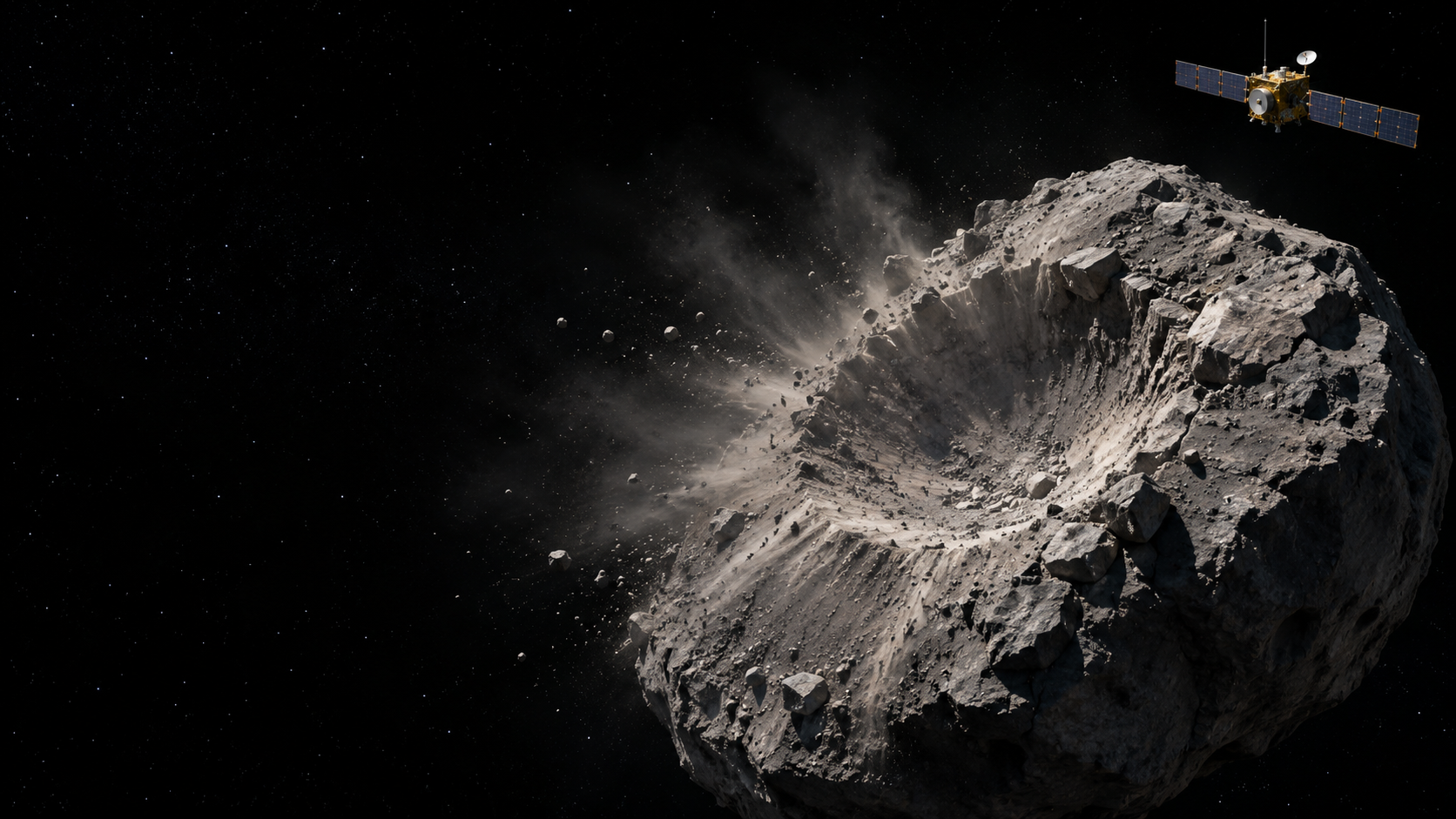
The impact did not destroy Dimorphos. Instead, it changed the asteroid’s surface, shape, and surrounding environment in ways that exceeded the simplest crater-forming scenario. Images from DART, the Italian Space Agency’s LICIACube, the Hubble Space Telescope, the James Webb Space Telescope, and Earth-based observatories revealed long debris streams and evidence of substantial material displacement.
The phrase “flattened half” should be treated cautiously. It is a dramatic description of widespread reshaping, not necessarily a formal measurement showing that exactly half of Dimorphos became flat. The scientific result is clearer: DART caused extensive deformation rather than leaving only a small, isolated crater.
What Is Dimorphos?
A Binary Asteroid System
Dimorphos is the smaller member of the near-Earth binary asteroid system 65803 Didymos. Didymos is the larger primary body, while Dimorphos orbits it as a natural satellite. Before the DART collision, Dimorphos completed one orbit around Didymos in approximately 11 hours and 55 minutes.
This arrangement made the system valuable for a planetary-defense experiment. Scientists did not need to measure a tiny change in Dimorphos’s path around the Sun. Instead, they could compare the time required for Dimorphos to orbit Didymos before and after impact. A change in that period would show whether the spacecraft had altered the moonlet’s motion.
Dimorphos was not on a collision course with Earth. DART was a controlled demonstration designed to test a kinetic-impact technique before it might be needed against a genuinely hazardous object. NASA describes the mission as the first full-scale demonstration of asteroid-deflection technology (Source 1).
Why Scientists Chose Dimorphos
A binary asteroid provided a built-in measuring system. Scientists could calculate the orbital period from repeated changes in the system’s brightness. As Dimorphos passed in front of or behind Didymos from Earth’s perspective, telescopes recorded regular dips in light. Comparing those dips before and after impact revealed the collision’s effect.
The target also offered an opportunity to study how a small asteroid responds to a high-speed collision. Scientists suspected that Dimorphos might be a rubble pile: a gravitationally bound collection of rocks, boulders, and dust with relatively weak internal cohesion.
That distinction matters. A dense, solid asteroid may confine much of an impact’s damage to a crater. A porous, loosely connected body can absorb energy through crushing, movement, landslides, and the ejection of large quantities of surface material.
NASA’s DART Mission and the Collision
The Planetary-Defense Goal
DART’s objective was simple: strike Dimorphos and change its orbit around Didymos. The spacecraft was a kinetic impactor, meaning it used its mass and speed rather than explosives.
The collision transferred momentum directly from DART to Dimorphos. However, the spacecraft’s impact was only part of the effect. Rock and dust blasted away from the asteroid carried momentum with them. Because the ejecta moved outward, Dimorphos received additional recoil in the opposite direction.
This additional push is known as momentum enhancement. It can make a kinetic impactor more effective than a calculation based only on spacecraft mass and speed would suggest. The result depends on the asteroid’s surface, porosity, strength, shape, and impact angle.
What Happened During the Impact
DART struck Dimorphos on September 26, 2022, at approximately 7:14 p.m. Eastern Daylight Time. NASA reported a collision speed of about 22,000 kilometers per hour, or 6.1 kilometers per second (Source 2).
The spacecraft’s DRACO camera transmitted increasingly detailed images during its final approach. Those images showed an irregular, boulder-covered object rather than a smooth sphere. The final frame was captured shortly before impact.
The collision was immediately followed by a broad plume of dust and rocky debris. Ground-based observations later showed that Dimorphos’s orbital period had shortened by approximately 33 minutes. NASA and mission scientists concluded that DART achieved a much larger orbital change than the mission’s minimum success threshold (Source 2).
The First Signs of Extensive Damage
A simple impact model might predict a crater surrounded by a relatively compact deposit. Instead, observatories saw a spectacular plume extending far from Dimorphos. LICIACube, which passed the system shortly after impact, photographed material fanning outward in multiple streams.
The Hubble Space Telescope later recorded several evolving tails and filaments. These structures showed that the debris did not behave like a single cloud expanding uniformly. Some material formed narrow streams, while other particles remained near the binary system or were pushed away by radiation pressure.
The plume’s scale suggested that DART excavated and accelerated a substantial amount of material. It also provided evidence that Dimorphos was mechanically weak enough for the collision to disturb a broad region.
New Images Reveal Extensive Damage
More Than a Localized Crater
The available images do not provide a simple before-and-after photograph of every part of Dimorphos’s surface. DART observed the asteroid before impact, while LICIACube viewed the system from a different angle afterward. Later telescopes mainly tracked the debris cloud rather than resolving the entire surface of the small asteroid.
Even so, the combined observations support a major disturbance. The impact produced ejecta over a wide region and appears to have triggered movement beyond the immediate contact point. Mission analyses describe the event as significant reshaping of a weak, rubble-pile body rather than a neat hole punched into a solid block.
The phrase “flattened half” therefore needs context. It may refer to a hemisphere that was visually or structurally altered, not to a precisely measured geometric flattening of 50 percent of the asteroid. A more accurate description is that DART caused large-scale deformation and material redistribution.
Evidence of Surface Collapse and Displacement
The impact environment included several features that reveal how Dimorphos responded:
- Large amounts of dust and rock were expelled.
- Ejecta formed broad fans, filaments, and elongated tails.
- Material traveled far beyond the expected local crater zone.
- The asteroid’s outline and surface structure were likely modified by excavation and collapse.
- Some debris may have entered temporary orbits around the Didymos system before dispersing or falling back.
Dimorphos’s weak gravity helped the debris travel long distances. On Earth, gravity quickly pulls most impact ejecta back to the ground. On a small asteroid, particles can remain airborne for a long time, move across the surface, escape into space, or become temporarily bound to the binary system.
Scientists distinguish between confirmed observations and interpretations. The debris plume and orbital-period change are directly supported by observations. The exact crater dimensions, amount of surface collapse, and final shape of Dimorphos require detailed modeling and future spacecraft measurements.
Dimorphos May Be a Rubble Pile
A rubble-pile asteroid is not a single unbroken slab. It is a collection of rocks and dust held together mainly by gravity, friction, and limited material cohesion. Such objects can contain large voids and weak zones.
Dimorphos’s response is consistent with that type of structure. The large ejecta volume and broad disturbance indicate that the impact energy was not confined to a small area. Material could shift, crush, slide, and separate under the force of the collision.
A monolithic rock would still produce ejecta, but its fracture pattern and crater formation could be more localized. A porous rubble pile may absorb energy by compacting and rearranging its components. Its surface can also fail over a larger area after the initial impact.
DART therefore functioned as more than a deflection test. It became a natural experiment in asteroid geology.
The Big Surprise: A Massive Ejecta Cloud
Debris Extended Far Beyond the Impact Site
The plume was one of the mission’s most important discoveries. LICIACube images showed complex structures spreading away from Dimorphos shortly after impact. Hubble observations over the following weeks and months revealed a changing debris environment, including a long tail and narrow features extending from the system (Source 3).
The shape of the plume carries information about the asteroid. Fast particles formed extended structures, while slower material stayed closer to Dimorphos. The distribution of particle speeds and sizes helps scientists estimate how much mass was removed and how strongly the surface resisted excavation.
Low gravity made the event visually dramatic. Dust and fragments that would have fallen quickly on Earth could drift through space. Some particles were likely small enough for sunlight to alter their trajectories, producing tails that resembled those of comets.
Ejecta Increased Momentum Transfer
The spacecraft delivered a direct impulse, but ejecta delivered an additional one. If material leaves the asteroid in one direction, the remaining asteroid recoils in the opposite direction. The faster and more massive the expelled material, the greater the additional recoil.
This effect helps explain why DART shortened Dimorphos’s orbital period by far more than the mission’s minimum requirement. NASA reported an initial reduction of about 32 minutes, later refined through continued observations to approximately 33 minutes (Source 2).
The result does not mean that every asteroid would respond similarly. Momentum enhancement depends on the target’s properties. A dense, strongly bonded object may produce less ejecta and receive a smaller additional push. A porous, weakly bound object may create a much larger debris plume and a greater recoil.
The Debris May Have Altered the Binary System
Some fragments may have remained near Didymos and Dimorphos after the collision. Others may have fallen back onto one of the bodies or escaped the system. Temporary debris can affect the system’s brightness and complicate long-term measurements of its orbit.
Researchers continue to study whether the impact changed Dimorphos’s rotation, orbital orientation, or shape. These effects are separate from the confirmed orbital-period change and require longer observations and detailed dynamical models.
What the Images Reveal About Asteroid Structure
Dimorphos Was Probably Not a Solid, Uniform Block
The event challenges any simple model of Dimorphos as a uniform rock. Its irregular shape, boulder-strewn surface, extensive ejecta, and apparent deformation point toward a complex internal structure.
Images alone cannot reveal every interior property. Scientists combine imaging with orbital measurements, brightness changes, radar data, and impact simulations. Together, these observations can help estimate density, porosity, strength, and mass distribution.
Porosity and Cohesion Shaped the Outcome
Porosity describes the empty space within an asteroid. Cohesion describes the forces that hold grains, rocks, and layers together. Both properties influence impact behavior.
High porosity can absorb energy through crushing and compaction. Low cohesion allows rocks and dust to move more easily. A rubble pile with weak internal binding can produce extensive ejecta without fully breaking apart.
Researchers use shape models, light curves, ejecta tracking, spectral observations, and numerical simulations to test these possibilities. The models must reproduce both the measured orbital change and the observed debris structures.
The Shape May Have Changed Dynamically
The impact may have triggered surface avalanches, regional collapse, and redistribution of loose material. Some changes could have occurred within seconds; others may have developed over hours or days as unstable slopes settled.
This distinction matters. A body can be altered directly by the impact and then continue changing under its own weak gravity. Future observations are needed to separate immediate excavation from later reshaping.
Why This Matters for Planetary Defense
A Successful Deflection Test Is Not a Universal Prediction
DART demonstrated that a spacecraft can alter an asteroid moonlet’s orbit. It did not establish one universal impact result for all asteroids.
A future mission must consider the target’s density, porosity, strength, rotation, shape, composition, and warning time. The same spacecraft could produce different outcomes against a compact metallic object, a fractured rocky asteroid, or a loosely bound rubble pile.
Unexpected Deformation Changes Mission Planning
A large debris cloud can help deflect an asteroid, but it may also create new monitoring challenges. An impact could produce fragments, change the target’s rotation, or complicate predictions of where material will travel.
That does not make kinetic impact inherently unsafe. It means mission designers must model both the desired deflection and possible fragmentation. The goal is to move a threatening object away from Earth without creating a less predictable population of hazardous fragments.
Hera Will Improve the Models
ESA’s Hera mission is designed to perform a detailed post-impact investigation of the Didymos system. Launched in October 2024, Hera is scheduled to reach the binary asteroid system in late 2026. It will study the impact site, Dimorphos’s mass, surface, and internal properties, and the wider consequences of DART (Source 4).
Hera’s measurements should help determine the crater’s size, measure Dimorphos more accurately, and test how well pre-impact models predicted the collision. Its observations will convert a dramatic demonstration into a better-calibrated planetary-defense technique.
How Scientists Confirmed the Changes
Spacecraft Imaging
DART’s final images established Dimorphos’s pre-impact shape and surface appearance. LICIACube’s images captured the immediate aftermath from a separate viewing position. These observations revealed the plume’s structure and the presence of large-scale ejecta.
Future Hera images will provide the most direct examination of the altered surface and impact site.
Ground-Based and Space-Based Telescopes
Telescopes measured changes in the binary system’s brightness and orbital period. Hubble and Webb observed the evolving debris environment, while Earth-based observatories continued monitoring the system after impact.
These instruments did not all resolve Dimorphos’s surface directly. Their strength was long-term monitoring: they tracked dust, tails, brightness changes, and orbital behavior over time.
Numerical Simulations
Researchers use impact simulations to test possible asteroid structures. A successful model must account for the measured orbital change, ejecta distribution, impact geometry, and the target’s observed shape.
Simulations are interpretations constrained by observations. They do not replace images, but they allow scientists to connect visible debris with hidden properties such as porosity and internal strength.
What Remains Unknown
Was Half of Dimorphos Literally Flattened?
There is no basis for treating “flattened half” as a precise scientific measurement without a source that defines the term. The phrase is best understood as headline language describing extensive disturbance or reshaping.
The verified conclusion is that DART affected more than a tiny point on the surface. The impact excavated a large amount of material and likely altered Dimorphos’s structure across a broad region.
How Much Material Escaped?
Researchers still need more precise estimates of total ejecta mass, particle-size distribution, escape speeds, and the fraction of material that returned to the surface.
Those measurements influence momentum-enhancement calculations. They also determine whether part of the debris remains in the binary system or disperses into interplanetary space.
Did the Impact Change Long-Term Stability?
Questions remain about Dimorphos’s rotation, mass distribution, orbital evolution, and future surface changes. Continued monitoring can show whether the post-impact system reached a stable state or continued to evolve.
Conclusion: DART Changed More Than an Asteroid’s Orbit
DART achieved its primary goal: it changed Dimorphos’s orbit around Didymos. The mission also produced an unexpected geological experiment. Instead of creating only a compact crater, the collision generated extensive ejecta and probably reshaped a weak, rubble-pile asteroid.
The big surprise was the scale of the response. Dimorphos behaved less like a solid billiard ball and more like a fragile gravitational aggregate capable of shifting, collapsing, and shedding material.
That finding matters for planetary defense. Deflection depends not only on spacecraft speed and mass, but also on the target’s composition and structure. Before attempting to move a hazardous asteroid, scientists must understand its density, rotation, strength, and likely ejecta response.
Frequently Asked Questions
Did NASA destroy Dimorphos?
No. DART disturbed and reshaped Dimorphos but did not completely destroy it. Surface disruption, deformation, fragmentation, and total destruction are different outcomes. Hera will provide stronger measurements of the moonlet’s post-impact state.
What was NASA’s DART mission designed to do?
DART tested whether a spacecraft could alter the orbit of an asteroid companion through a high-speed kinetic impact. It was a planetary-defense demonstration, not an attempt to destroy an asteroid threatening Earth.
What is the big surprise revealed by the images?
The main surprise is the scale of the ejecta and surface disturbance. The impact produced broad debris structures and likely affected more than a small crater-sized area. “Flattened half” is headline wording unless a scientific source defines it more precisely.
Why did Dimorphos produce so much debris?
Dimorphos’s low gravity, loose surface material, porosity, and weak internal structure probably allowed a large amount of material to escape the impact region. Scientists are still determining how much each factor contributed.
Did DART prove that asteroids can be deflected?
Yes. DART demonstrated orbital deflection in the Didymos–Dimorphos system. However, other asteroids may respond differently because their size, density, strength, rotation, and composition vary.
Could this discovery help protect Earth?
Yes. The findings improve models of asteroid impacts and momentum transfer. Effective planetary defense still requires early detection, accurate target characterization, sufficient warning time, and a mission designed for the specific asteroid.
Related Articles
-
 NASA-SpaceX Cygnus XL Mission to the ISS
-
 Last Chance to See the Planet Parade: A Local Guide
-
 Why Does a Magnet Make a Candle Flame Move?
-
 How Moon Dust and Cardboard Could Build Lunar Bases
-
 Caltech’s 90-Year JPL Role Faces New Scrutiny
-
 SpaceX Scrubs Space Force Data-Network Launch
-
 Cygnus Launch Live: NASA, SpaceX, and ISS Cargo Mission
-
 Sutherland and Exoplanet Radio Signals Explained
-
 Prospector's Rock Was a 4.6-Billion-Year-Old Meteorite
-
 Giant Deep-Space Structure Tests Cosmological Models
-
 Mammoth Fossils Reported Near Lafayette, Louisiana
-
 Hera Reveals DART’s Stadium-Sized Crater on Dimorphos
-
 Denisovan Teeth in Southern China May Reveal New Lineage
-
 How Contractility Controls Cardiomyocyte Regeneration
-
 Could Dark Matter Have Its Own Periodic Table?
-
 Ancient Skull Offers Clues to Bone-Cracking Hyena Evolution